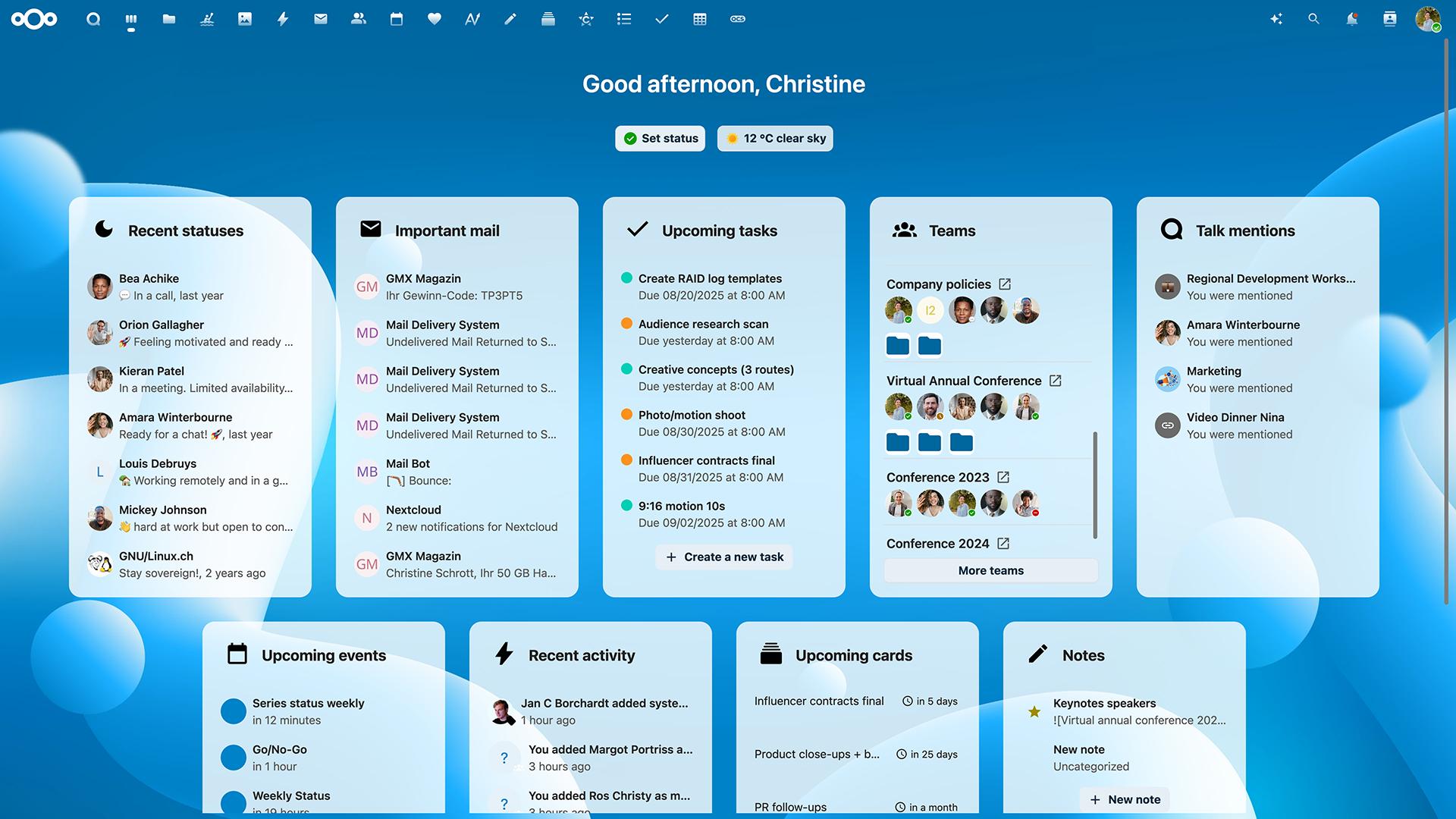
Small and medium-sized enterprises increasingly operate across multiple offices, remote workers, contractors, engineering teams, clients, suppliers, and field personnel. Traditional file servers, email attachments, consumer cloud storage, VPN-only architectures, and disconnected collaboration applications can create fragmented information environments.
Nextcloud provides an alternative architecture: an organization can operate its own collaboration platform on infrastructure it controls, while still providing browser, desktop, and mobile access. Nextcloud supports installation on Linux servers, Docker-based deployments, web hosting, virtual machines, and hosted services. (Nextcloud)
Research White Paper
Nextcloud Collaboration Server for Local, Private Cloud, and Hybrid Business Operations
Designing a Secure Collaboration Platform for SMEs with KeenComputer as the Strategic Technology Partner
Executive Summary
Small and medium-sized enterprises increasingly operate across multiple offices, remote workers, contractors, engineering teams, clients, suppliers, and field personnel. Traditional file servers, email attachments, consumer cloud storage, VPN-only architectures, and disconnected collaboration applications can create fragmented information environments.
Nextcloud provides an alternative architecture: an organization can operate its own collaboration platform on infrastructure it controls, while still providing browser, desktop, and mobile access. Nextcloud supports installation on Linux servers, Docker-based deployments, web hosting, virtual machines, and hosted services. (Nextcloud)
This paper proposes a KeenComputer-led Nextcloud strategy in which Nextcloud becomes part of an SME's broader digital infrastructure rather than simply another file-sharing application.
The proposed architecture supports:
- Local/on-premises deployment
- Private cloud deployment
- VPS/cloud deployment
- Hybrid local + cloud architectures
- Multi-office collaboration
- Remote and mobile workers
- Document management
- Engineering collaboration
- Legal document collaboration
- Medical/healthcare administrative workflows
- Construction-project collaboration
- Business operations
- Secure client and supplier file exchange
- Backup and disaster recovery
- Integration with existing Joomla, WordPress, Magento, CRM, ERP and AI/RAG systems
KeenComputer's strategic role is to provide assessment, architecture, implementation, migration, security hardening, integration, monitoring, backup, training and ongoing operations.
1. The Business Problem
Many SMEs have accumulated several disconnected information systems:
Email │ ├── Attachments ├── Local PCs ├── USB drives ├── Office file servers ├── OneDrive/Google Drive/Dropbox ├── NAS ├── SharePoint ├── CRM ├── ERP └── Website/CMS
The result can be an information environment where employees spend significant time answering questions such as:
- Where is the latest document?
- Who has the current version?
- Can I access the document from another office?
- Which documents can the client see?
- Can an employee access the system remotely?
- What happens when an employee leaves?
- How are confidential documents protected?
- How are files backed up?
- How quickly can the organization recover from ransomware?
- Can engineering and business teams collaborate without duplicating files?
The fundamental issue is therefore not simply file storage.
It is organizational information management.
2. Nextcloud as a Digital Collaboration Layer
Nextcloud can provide a central collaboration layer between users, offices, applications and organizational data.
A simplified architecture is:
INTERNET │ Firewall / UTM / WAF │ Reverse Proxy / TLS │ NEXTCLOUD │ ┌────────────────────┼────────────────────┐ │ │ │ Files Users Apps │ │ │ ├── Documents ├── Groups ├── Calendar ├── Projects ├── Departments ├── Contacts ├── Templates ├── Clients ├── Talk └── Archives └── External Users └── Workflow │ ┌──────────┼──────────┐ │ │ │ Office Mobile Remote PCs Users Workers
The Nextcloud desktop client can synchronize folders between the server and Windows, macOS and Linux systems. (docs.nextcloud.com)
This makes Nextcloud particularly relevant to SMEs that need a consistent information environment across multiple locations.
3. Local, Cloud and Hybrid Deployment Models
There is no universal infrastructure model for every organization. KeenComputer can therefore design three primary deployment patterns.
3.1 Local Nextcloud Server
The organization operates Nextcloud on its own premises.
INTERNET │ Firewall │ Office Network │ Nextcloud Server │ │ NAS Backup │ ┌──────┼──────┐ PC PC PC
Appropriate for
- Engineering companies
- Law firms
- Construction companies
- Medical organizations
- Manufacturing companies
- Organizations with significant local data
- Organizations requiring local control of primary data
Advantages
- Local data ownership
- High LAN performance
- Reduced dependence on internet connectivity for local access
- Integration with local Active Directory/LDAP
- Integration with NAS and backup infrastructure
- Ability to maintain sensitive workloads locally
The server can be deployed on a dedicated Linux server or virtual machine. Nextcloud's current documentation lists Ubuntu 26.04 LTS among supported operating systems and supports database choices including PostgreSQL and several MySQL/MariaDB versions. (docs.nextcloud.com)
4. Private Cloud / VPS Deployment
A second architecture places Nextcloud in a professionally managed VPS or cloud environment.
Office A ─────┐ │ Office B ─────┼──── Internet ──── Nextcloud VPS │ │ Remote ───────┤ ├── Database │ ├── Storage Mobile ───────┘ └── Backup
This approach is useful when an SME does not want to operate physical servers.
A VPS can provide:
- Dedicated resources
- Public HTTPS access
- Centralized administration
- Geographic accessibility
- Automated backup
- Monitoring
- Firewall controls
- Disaster-recovery options
For organizations already operating Linux VPS infrastructure, Nextcloud can become another managed business service.
5. Docker-Based Nextcloud Architecture
Docker provides another deployment model.
Ubuntu Server │ Docker │ ├── Nextcloud ├── Database ├── Redis ├── Reverse Proxy ├── Monitoring └── Backup Services
This approach is particularly attractive for organizations already using Docker Compose.
However, containerization does not eliminate operational responsibility.
The organization still needs:
- Persistent storage
- Database backups
- Application backups
- Security updates
- TLS certificates
- Monitoring
- Logging
- Disaster recovery
- Capacity planning
Nextcloud's official installation resources include Docker images alongside other deployment approaches. (Nextcloud)
6. Hybrid Nextcloud Architecture
For geographically distributed organizations, the hybrid model can combine local infrastructure with cloud infrastructure.
CLOUD / VPS NEXTCLOUD │ ┌────────┴────────┐ │ │ Office A Office B LAN Server LAN Users │ Local NAS │ Local Backup + Cloud Backup
The architecture can separate:
Primary collaboration
from
Backup and disaster recovery
rather than treating a single Nextcloud server as the entire backup strategy.
This distinction is important.
Nextcloud is a collaboration platform; it should not automatically be treated as the organization's only backup system.
7. Multi-Office Collaboration
Consider a professional organization with:
- Winnipeg headquarters
- Toronto office
- Vancouver office
- India engineering office
- Remote employees
- External consultants
- Clients
Instead of maintaining independent file repositories:
Toronto File Server Vancouver File Server Winnipeg NAS India File Server Employee laptops Email attachments
the organization can create a common collaboration environment.
NEXTCLOUD │ ┌───────────────┼───────────────┐ │ │ │ Legal Engineering Business │ │ │ Clients Projects Operations │ │ │ └───────────────┼───────────────┘ │ Remote Employees
Access can then be organized around:
- Departments
- Projects
- Clients
- Offices
- Teams
- Security groups
- External collaborators
8. Use Case: Law Firm
Law firms have substantial document-management requirements.
A Nextcloud architecture can support:
CLIENT │ └── Matter │ ├── Contracts ├── Evidence ├── Correspondence ├── Court Documents ├── Research ├── Discovery └── Billing Documents
Example
A lawyer working from Winnipeg can access a client matter while another lawyer works from Toronto.
A controlled external sharing workflow can provide selected documents to:
- Clients
- Expert witnesses
- Accountants
- Consultants
- Other counsel
The objective is not merely convenient file sharing.
It is controlled information exchange.
Additional requirements
A law-firm deployment should consider:
- MFA
- Strong password policies
- Least privilege
- Audit logging
- Retention policies
- Encryption
- Secure external sharing
- Backup
- Disaster recovery
- Employee offboarding
- Client/matter separation
KeenComputer can translate those requirements into a documented security architecture rather than treating Nextcloud as a standalone application.
9. Use Case: Engineering Company
Engineering organizations often deal with very large and complex information sets.
Example:
PROJECT-2026-001 │ ├── Requirements ├── Specifications ├── Drawings ├── CAD ├── Simulation ├── Software ├── Test Results ├── Procurement ├── Vendor Documents ├── Meeting Minutes └── Final Deliverables
Nextcloud can act as the collaboration layer surrounding engineering systems.
For example:
Nextcloud │ ├── Engineering Documents │ ├── Git / GitLab │ ├── CAD/PDM │ ├── Simulation │ ├── Jira/Project Management │ └── ERP
This architecture avoids trying to make one platform perform every engineering function.
Instead:
Nextcloud becomes the information-exchange layer connecting people and engineering systems.
10. Use Case: Medical Organization
Healthcare-related deployments require particularly careful consideration of privacy, security, regulatory requirements and organizational policies.
Potential use cases include:
- Administrative documents
- Research collaboration
- Internal policies
- Training materials
- Non-clinical project documentation
- Interdepartmental collaboration
- Controlled document exchange
- Research datasets where appropriate controls exist
A medical deployment should undergo a formal privacy and security assessment appropriate to the jurisdiction and data involved.
For example:
Medical Organization │ ├── Clinical Systems │ ├── EMR/EHR │ ├── Laboratory Systems │ ├── Imaging │ └── Nextcloud │ Administrative/ Collaboration Data
The architectural principle is important:
Nextcloud should not automatically become the repository for every category of medical information.
KeenComputer can help define the boundary between collaboration data and regulated clinical systems.
11. Use Case: Civil Construction
Construction organizations often have geographically distributed stakeholders.
A typical project may involve:
- Owner
- General contractor
- Subcontractors
- Architect
- Civil engineer
- Structural engineer
- Electrical engineer
- Mechanical engineer
- Surveyor
- Municipality
- Inspectors
- Suppliers
A project workspace can be organized as:
PROJECT │ ├── Contract ├── Drawings ├── Specifications ├── RFIs ├── Change Orders ├── Site Photos ├── Inspection Reports ├── Safety ├── Procurement ├── Schedules ├── Invoices └── As-Built Documentation
Field personnel can access project information through mobile devices while office personnel manage the broader document environment.
This can reduce dependence on:
- USB drives
- email attachments
- uncontrolled file copies
- personal cloud accounts
12. Use Case: Business Operations
A typical SME can structure Nextcloud around departments:
Company │ ├── Executive ├── Finance ├── Human Resources ├── Sales ├── Marketing ├── Operations ├── Engineering ├── IT ├── Customers └── Projects
Each department can have different access policies.
For example:
|
Information |
Executive |
Finance |
Sales |
Engineering |
|---|---|---|---|---|
|
Corporate policies |
✓ |
✓ |
✓ |
✓ |
|
Financial records |
✓ |
✓ |
Limited |
— |
|
Sales proposals |
✓ |
— |
✓ |
Selected |
|
Engineering designs |
✓ |
— |
Selected |
✓ |
|
HR documents |
✓ |
Limited |
— |
— |
The exact permissions should be designed according to the organization's requirements rather than copied from a generic template.
13. Client and Supplier Collaboration
One particularly valuable capability is controlled external collaboration.
Instead of:
"I'll email you the ZIP file."
the organization can provide a controlled shared workspace.
Company │ ├── Client A │ └── Project Workspace │ ├── Client B │ └── Project Workspace │ └── Supplier C └── Procurement Workspace
This creates a more structured information exchange model.
14. Nextcloud Desktop and Mobile Strategy
The collaboration architecture should include user endpoints.
NEXTCLOUD │ ┌─────────────┼─────────────┐ │ │ │ Browser Desktop Mobile │ │ │ Web UI Sync Client Mobile Apps
Nextcloud documents desktop synchronization for Windows, macOS and Linux, while mobile clients are available for Android and iOS. (docs.nextcloud.com)
This enables a distributed workforce to work with a common information environment.
15. Identity and Access Management
A production deployment should treat identity as a first-class architectural component.
Potential integration points include:
Identity │ ┌───────────┼───────────┐ │ │ │ LDAP Active SSO Directory │ Nextcloud
KeenComputer can design:
- User provisioning
- Group management
- Department permissions
- MFA
- Administrative roles
- External-user policies
- Employee onboarding
- Employee offboarding
The objective is to make access follow organizational responsibility.
16. Security Architecture
A recommended SME deployment should use multiple security layers.
Internet │ Cloud Firewall │ VPS Firewall / UFW │ Reverse Proxy │ TLS │ Nextcloud │ Database │ Encrypted/Protected Storage │ Backup
Additional controls can include:
- MFA
- Fail2ban where appropriate
- Security headers
- Rate limiting
- Monitoring
- Vulnerability management
- Log analysis
- Malware scanning
- Backup verification
- Off-site backups
- Disaster-recovery testing
This follows a defense-in-depth approach.
17. Backup Architecture
A Nextcloud implementation should distinguish among:
- Application configuration
- Database
- User files
- Encryption keys where applicable
- Server configuration
- Logs
- Backup metadata
A possible architecture is:
NEXTCLOUD │ ┌─────────┼─────────┐ │ │ │ Database Files Config │ │ │ └─────────┼─────────┘ │ Backup System │ │ Local Off-site Backup Backup
A useful operational principle is:
A backup is not complete until restoration has been tested.
18. Disaster Recovery
SMEs should define recovery objectives before deployment.
Examples include:
- RPO — how much data can potentially be lost?
- RTO — how quickly must the service return?
For example:
Primary Nextcloud │ ├── Local Backup │ ├── Off-site Backup │ └── Recovery Server
KeenComputer can create a documented disaster-recovery runbook containing:
- Incident identification
- Service isolation
- Backup validation
- Infrastructure recovery
- Database restoration
- File restoration
- Application validation
- User reconnection
- Security investigation
- Post-incident review
19. Nextcloud and Existing SME Infrastructure
Nextcloud should not exist in isolation.
For a typical KeenComputer customer:
SME IT │ ┌───────────────────┼────────────────────┐ │ │ │ Nextcloud CRM ERP │ │ │ ├── Joomla ├── vTiger │ ├── WordPress ├── Mautic │ ├── Magento └── Marketing │ │ ├── Backup ├── Monitoring ├── Docker └── AI/RAG
This is where KeenComputer's broader IT architecture becomes important.
20. Nextcloud and AI/RAG
A future-oriented architecture can connect Nextcloud document repositories with organizational AI systems.
NEXTCLOUD │ Document Store │ Extraction/OCR │ Chunking │ Vector Database │ RAG Engine │ LLM / Agent │ Employee Assistant
Potential applications include:
Engineering
"Find the design specification for subsystem X."
Legal
"Locate the documents associated with this matter."
Construction
"Find the latest approved drawing."
Business
"Find the current version of the supplier contract."
IT
"Find the server deployment procedure."
The AI system should preserve authorization boundaries.
A user should not gain access to confidential information merely because an AI system can index it.
21. Nextcloud as a Knowledge Infrastructure
This leads to a broader concept:
Nextcloud can become an organizational knowledge infrastructure rather than merely a cloud drive.
The progression is:
File Storage ↓ Document Collaboration ↓ Project Collaboration ↓ Organizational Knowledge ↓ AI-Accessible Knowledge ↓ Intelligent Business Operations
This creates opportunities for SMEs to gradually introduce AI without immediately replacing their existing business systems.
22. KeenComputer Strategic Role
KeenComputer can position itself as the SME Nextcloud implementation and managed-services partner.
The service lifecycle can be structured as:
ASSESS ↓ DESIGN ↓ IMPLEMENT ↓ MIGRATE ↓ SECURE ↓ INTEGRATE ↓ TRAIN ↓ MONITOR ↓ OPTIMIZE
Phase 1 — Assessment
Review:
- Existing file servers
- NAS
- Cloud storage
- Users
- Offices
- Internet connectivity
- Security
- Backup
- Compliance requirements
- Applications
- Document volumes
23. Phase 2 — Architecture
KeenComputer defines:
- Local vs cloud vs hybrid
- Storage architecture
- Database
- Network
- Firewall
- TLS
- Identity
- Backup
- Disaster recovery
- Monitoring
- User groups
- External collaboration
24. Phase 3 — Implementation
KeenComputer can implement:
- Ubuntu Linux
- Docker
- Nextcloud
- Database
- Redis
- Reverse proxy
- TLS
- Storage
- Firewall
- Monitoring
- Backup
- Desktop clients
- Mobile clients
Nextcloud's current documentation supports Ubuntu 26.04 LTS and provides database and PHP compatibility guidance that should be checked against the exact Nextcloud release selected for production. (docs.nextcloud.com)
25. Phase 4 — Migration
A controlled migration can follow:
Inventory ↓ Classify ↓ Clean ↓ Deduplicate ↓ Define Ownership ↓ Define Permissions ↓ Pilot ↓ Migrate ↓ Validate ↓ Retire Legacy Storage
This prevents the common mistake of moving an organization's existing disorder into a new platform.
26. Phase 5 — Security Hardening
KeenComputer's security service can include:
Network
- Firewall
- UFW
- Cloud firewall
- VPN
- Segmentation
Application
- Security updates
- Secure configuration
- Trusted domains
- TLS
- Security headers
- App governance
Identity
- MFA
- Least privilege
- Group policies
- Administrative separation
Operations
- Monitoring
- Logging
- Backup
- Recovery testing
- Incident procedures
27. Phase 6 — Managed Operations
KeenComputer can provide ongoing:
- Patch management
- Monitoring
- Backup verification
- Security reviews
- Capacity planning
- User administration
- Application management
- Performance optimization
- Disaster-recovery testing
This converts Nextcloud from a one-time installation into a managed business platform.
28. SME Implementation Packages
A practical commercial structure could be:
Nextcloud Foundation
For small organizations:
- Nextcloud installation
- HTTPS
- Basic users/groups
- Desktop clients
- Backup
- Documentation
Nextcloud Business
Adds:
- Multi-office architecture
- Advanced permissions
- MFA
- Monitoring
- External collaboration
- Migration
- Security hardening
Nextcloud Enterprise Integration
Adds:
- Hybrid cloud
- LDAP/AD
- CRM integration
- AI/RAG integration
- Advanced backup
- Disaster recovery
- Monitoring
- Managed services
The exact pricing should be based on users, storage, infrastructure, migration complexity and support requirements rather than a fixed generic price.
29. Governance Model
Technology alone does not create effective collaboration.
Organizations should establish:
Technology + People + Processes + Security + Governance
Recommended policies include:
- Document naming
- Folder structure
- Ownership
- Access control
- External sharing
- Retention
- Backup
- Employee departure
- Client termination
- Project closure
- Disaster recovery
30. A Practical 90-Day Deployment Roadmap
Days 1–15 — Discovery
Inventory:
- Users
- Offices
- Storage
- Applications
- Security
- Backup
- Network
- Compliance requirements
Days 16–30 — Architecture
Select:
- Local
- VPS
- Hybrid
- Docker
- Storage
- Database
- Identity
- Backup
Days 31–45 — Pilot
Deploy a limited environment.
Select:
- IT
- One business department
- One project
- Several representative users
Days 46–60 — Migration
Move selected information.
Test:
- Permissions
- Synchronization
- External sharing
- Backup
- Recovery
Days 61–75 — Organization-wide Deployment
Deploy:
- Departments
- Offices
- Remote users
- Mobile users
Days 76–90 — Optimization
Measure:
- Adoption
- Performance
- Storage
- Security
- Backup
- User experience
Then establish the ongoing managed-service model.
31. Strategic Positioning of KeenComputer
KeenComputer should not position Nextcloud merely as:
"We install a cloud server."
A stronger business proposition is:
KeenComputer helps SMEs design, deploy, secure and operate private collaboration infrastructure that connects employees, offices, clients, projects and business systems.
Nextcloud becomes one component of that architecture.
The broader KeenComputer capability can encompass:
IT Infrastructure
→ Linux
→ Windows
→ Networking
→ Firewalls
→ VPS
→ Docker
Business Applications
→ Nextcloud
→ Joomla
→ WordPress
→ Magento
→ CRM
→ Marketing automation
Security
→ Firewall
→ Hardening
→ Monitoring
→ Backup
→ Disaster recovery
Engineering
→ Software engineering
→ AI/RAG
→ Embedded systems
→ Engineering collaboration
Managed Services
→ Monitoring
→ Maintenance
→ Security updates
→ Backup
→ Technical support
32. Relationship with IAS-Research and KeenDirect
The three-company ecosystem can also be positioned around different layers of the customer's technology lifecycle.
KeenComputer
Design → Deploy → Secure → Operate
IAS-Research
Research → Architecture → Innovation → AI → Engineering
KeenDirect
Hardware → Components → Infrastructure → Procurement
Together:
SME CUSTOMER │ ┌─────────────┼─────────────┐ │ │ │ KeenComputer IAS-Research KeenDirect │ │ │ IT Deployment Research Hardware Security AI/RAG Components Cloud Engineering Infrastructure Managed IT Innovation Procurement │ │ │ └─────────────┼─────────────┘ │ Digital Transformation
33. Research and Innovation Opportunity
The Nextcloud platform can also become an experimental platform for IAS-Research.
Potential research areas include:
- AI-assisted document management
- RAG over enterprise documents
- Knowledge graphs
- Agentic document workflows
- Secure enterprise AI
- Engineering knowledge management
- Intelligent document classification
- Automated metadata extraction
- Semantic search
- Document lifecycle automation
This creates a pathway from:
Traditional File Server
to
Private Cloud
to
Enterprise Knowledge Platform
to
AI-Assisted Knowledge Infrastructure
34. Key Architectural Principle
The most important architectural decision is not whether an organization should simply "move to Nextcloud."
The more useful question is:
What information should the organization own, where should it reside, who should access it, how should it be protected, and how should it participate in business workflows?
Nextcloud can then be evaluated as one component of that architecture.
35. Conclusion
Nextcloud provides SMEs with a flexible foundation for private and hybrid collaboration. Its ability to operate on Linux infrastructure, connect through web, desktop and mobile clients, and support different deployment models makes it applicable to organizations ranging from small offices to geographically distributed professional and engineering organizations. (docs.nextcloud.com)
For law firms, it can support controlled document collaboration.
For engineering organizations, it can provide a project-information layer.
For construction companies, it can facilitate geographically distributed project collaboration.
For medical organizations, it can support carefully scoped administrative and research collaboration subject to applicable privacy and security requirements.
For general SMEs, it can provide a foundation for controlled document sharing, remote work and multi-office collaboration.
The strategic opportunity for KeenComputer is broader than installation. It is to become the organization's collaboration infrastructure partner, combining Nextcloud with Linux, Docker, networking, cybersecurity, backup, monitoring, CRM, CMS, ecommerce, AI/RAG and managed IT services.
The resulting architecture is:
Own the infrastructure where appropriate. Control the information. Secure the access. Connect the offices. Integrate the applications. Preserve the knowledge. Then progressively introduce AI.
Recommended Reference
The official Nextcloud documentation should remain the primary technical reference when selecting the production release, supported operating system, database, PHP version and client configuration because these requirements change between releases. (docs.nextcloud.com)