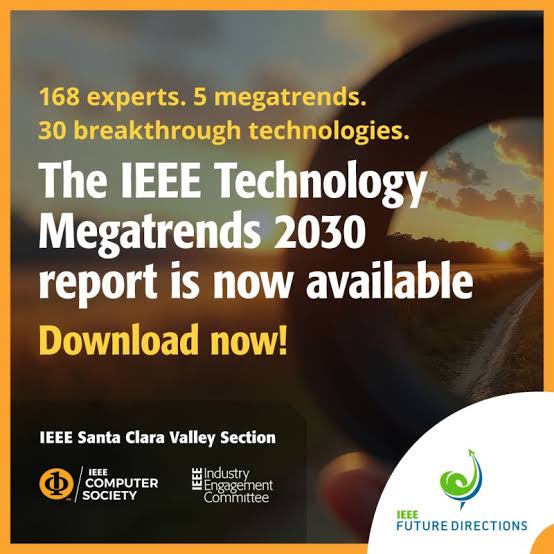
The period leading to 2030 is likely to represent a fundamental transition in the way engineering, scientific research, manufacturing, professional services and small and medium-sized enterprises operate.
The central finding of this paper is that Artificial Intelligence should no longer be treated simply as another software tool. The IEEE Technology Megatrends 2030 material characterizes AI as becoming general-purpose infrastructure and identifies strong interactions among AI, energy, health, space and physical AI/robotics. It also identifies energy availability, trust, governance, cybersecurity, explainability and human-AI interaction as critical conditions for scaling these technologies.
For working engineers and scientists, this means that technical expertise alone will increasingly be insufficient. The professional who combines domain expertise + AI literacy + systems thinking + critical thinking + experimentation + communication + business understanding is likely to be substantially better positioned than one who treats AI as either a threat or a purely administrative productivity tool.
For SMEs, the opportunity is even more significant. AI can lower the cost of research, software development, engineering analysis, marketing, customer support, documentation, knowledge management and automation. However, the central SME challenge is not simply "How do we buy AI?" It is:
Where can AI create measurable business, engineering or scientific value, and how can it be deployed safely, economically and repeatedly?
Research White Paper
Engineering and Scientific Work in the AI-Driven 2030 Economy
What the Technology Megatrends Mean for the USA, Canada, India and the UK — and a Strategic Action Plan for Engineers, Scientists, Engineering Organizations and SMEs
Publication Draft — September 2026
Abstract
The period leading to 2030 is likely to represent a fundamental transition in the way engineering, scientific research, manufacturing, professional services and small and medium-sized enterprises operate.
The central finding of this paper is that Artificial Intelligence should no longer be treated simply as another software tool. The IEEE Technology Megatrends 2030 material characterizes AI as becoming general-purpose infrastructure and identifies strong interactions among AI, energy, health, space and physical AI/robotics. It also identifies energy availability, trust, governance, cybersecurity, explainability and human-AI interaction as critical conditions for scaling these technologies.
For working engineers and scientists, this means that technical expertise alone will increasingly be insufficient. The professional who combines domain expertise + AI literacy + systems thinking + critical thinking + experimentation + communication + business understanding is likely to be substantially better positioned than one who treats AI as either a threat or a purely administrative productivity tool.
For SMEs, the opportunity is even more significant. AI can lower the cost of research, software development, engineering analysis, marketing, customer support, documentation, knowledge management and automation. However, the central SME challenge is not simply "How do we buy AI?" It is:
Where can AI create measurable business, engineering or scientific value, and how can it be deployed safely, economically and repeatedly?
This paper develops a practical framework for SMEs and engineering organizations in India, Canada, the USA and the UK, while recognizing that each country operates within a different economic, regulatory, infrastructure and talent environment.
The paper combines the IEEE 2030 megatrend perspective with the buyer-research principles contained in Adele Revella's Buyer Personas, particularly the emphasis on understanding actual decision-making, customer expectations and buying insights rather than relying on assumptions or demographic profiles.
1. Executive Summary
The world entering the second half of the 2020s is moving toward an economy in which:
- AI becomes embedded into everyday work.
- AI agents increasingly execute multi-step workflows.
- Physical AI connects software intelligence to machines, robots and industrial systems.
- Energy becomes a strategic constraint on computing.
- Engineering becomes increasingly interdisciplinary.
- Cybersecurity becomes inseparable from AI adoption.
- Scientific research becomes increasingly computational and AI-assisted.
- Engineers increasingly work with AI copilots, agents and digital twins.
- SMEs gain access to capabilities previously affordable mainly to large corporations.
- Human judgment, verification, ethics and accountability become more important—not less.
The IEEE material explicitly identifies accelerated AI adoption, workforce reskilling, automation and growing demand for energy to support AI as major developments toward 2030.
It also identifies an important paradox:
AI can automate work while simultaneously increasing demand for higher-level human capabilities.
The resulting labour market may therefore produce:
Jobs without people — and people without the right jobs.
The IEEE skills analysis highlights cybersecurity, AIOps, heterogeneous computing, data discernment, critical thinking, human verification, AI agents, LLMs, human-in-the-loop safety, cybersecurity, systems thinking, AI-assisted hardware/software development, clean-energy systems, digital twins, robotics and precision engineering.
For engineers and scientists, the strategic response should therefore not be:
Human versus AI
but:
Human + AI + domain expertise + physical systems + trusted data.
2. Research Foundation
This white paper is based primarily on three sources of evidence and analysis:
2.1 IEEE Technology Megatrends 2030
The IEEE material was developed through a broad international process involving contributors from academia, industry, government and professional organizations. The documented team included contributors from 38 countries, including Canada, India, the UK and the USA.
The report identifies five major technology megatrends:
- Artificial Intelligence
- Energy
- Health
- Space
- Physical AI
The framework emphasizes that megatrends are interconnected technological, economic, ecological and socio-political forces rather than isolated technologies.
2.2 Buyer-Decision Research
A second foundation is Adele Revella's buyer research methodology.
The central principle is particularly important for engineering organizations:
Do not design products, services or transformation programs based solely on what management assumes customers want.
Instead, organizations should understand:
- what triggered the buyer's search;
- what success means to the buyer;
- what alternatives were considered;
- what concerns prevented action;
- who influenced the decision;
- what evidence created confidence;
- and why the buyer ultimately selected one solution over another.
Revella emphasizes that authentic buyer stories provide insight into expectations and decision factors that ordinary demographic profiling cannot provide.
This principle becomes especially important as engineering firms sell increasingly complex AI, cybersecurity, energy, automation and digital-transformation solutions.
2.3 Current Policy and Industry Evidence
The analysis is supplemented with current government and institutional developments in the four target markets.
For example, Canada's current AI strategy explicitly identifies SME barriers such as cost, expertise and uncertainty and emphasizes moving businesses from experimentation toward practical impact. (ISED Canada)
The UK's 2026 SME digital-adoption program similarly targets stronger SME digital and AI capability, while current UK research emphasizes the gap between experimentation and deeper integration. (GOV.UK)
India's IndiaAI Mission includes compute, datasets, innovation, applications, future skills, startup financing and safe/trusted AI, with explicit attention to AI adoption among MSMEs. (Press Information Bureau)
In the USA, NIST's AI Risk Management Framework provides a widely applicable structure for managing AI risks and trustworthy AI development, while its 2026 work continues to expand AI evaluation and critical-infrastructure guidance. (NIST)
3. The Central 2030 Thesis
From Digital Transformation to Intelligent Transformation
The first wave of digital transformation converted:
paper → digital data
The second wave converted:
manual processes → software workflows
The emerging third wave is converting:
software workflows → intelligent, partially autonomous systems
This distinction is fundamental.
An SME should not ask:
"Where can we put AI?"
It should ask:
"Which important business, engineering or scientific decisions and workflows can be improved through trusted intelligence?"
The IEEE analysis identifies agentic AI, multimodal AI, explainability, privacy and guardrails as important developments, while emphasizing that AI, energy and computing infrastructure must increasingly be treated as an interconnected systems problem.
4. The Five Forces Reshaping Engineering
4.1 Artificial Intelligence
AI becomes infrastructure.
It will increasingly appear inside:
- engineering software;
- CAD;
- simulation;
- documentation;
- research;
- programming;
- cybersecurity;
- customer service;
- ERP;
- CRM;
- manufacturing;
- logistics;
- marketing;
- knowledge management;
- scientific discovery.
The important transition is from:
AI as application
to:
AI as organizational capability.
4.2 Energy
AI requires computation.
Computation requires:
- electricity;
- data centers;
- cooling;
- networking;
- storage;
- semiconductor infrastructure.
The IEEE analysis explicitly identifies energy availability and efficiency as binding constraints on digital progress.
This creates major opportunities for engineers working in:
- power electronics;
- renewable energy;
- smart grids;
- distributed energy resources;
- microgrids;
- energy storage;
- thermal management;
- power quality;
- semiconductor efficiency;
- data-center infrastructure.
The convergence of AI + Energy may therefore become one of the most important engineering opportunities of the decade.
5. Physical AI
The next major transition is from intelligence operating primarily in the digital world to intelligence operating in the physical world.
Examples include:
- autonomous vehicles;
- robotics;
- industrial automation;
- drones;
- intelligent manufacturing;
- autonomous laboratories;
- agricultural robots;
- warehouse automation;
- medical robotics;
- smart infrastructure.
IEEE identifies physical AI and robotics as a major megatrend and notes the importance of machine vision, edge AI, generative AI, simulation, cloud robotics and low-latency connectivity.
For engineers, this means that the boundary between:
electrical engineering + mechanical engineering + software + AI + controls
will increasingly disappear.
6. The Engineer of 2030
The traditional engineering career model often looked like:
Degree → specialization → employment → experience → management
The emerging model is closer to:
Domain expertise → continuous learning → AI augmentation → interdisciplinary engineering → systems leadership
The engineer of 2030 should therefore develop seven layers of capability.
Layer 1 — Fundamental engineering
- mathematics;
- physics;
- circuits;
- mechanics;
- control;
- thermodynamics;
- materials;
- computer science.
Layer 2 — Domain specialization
Examples:
- power systems;
- embedded systems;
- VLSI;
- telecommunications;
- automotive;
- manufacturing;
- aerospace;
- energy;
- biomedical engineering.
Layer 3 — Computational capability
- Python;
- numerical methods;
- simulation;
- data engineering;
- cloud computing;
- containers;
- APIs;
- version control.
Layer 4 — AI capability
- LLMs;
- multimodal AI;
- machine learning;
- RAG;
- AI agents;
- prompt/context engineering;
- model evaluation;
- AI-assisted development.
Layer 5 — Systems thinking
The IEEE recommendations specifically emphasize holistic/system thinking, human verification, ethics, governance and interdisciplinary capability.
Layer 6 — Human capability
- critical thinking;
- communication;
- leadership;
- negotiation;
- scientific reasoning;
- customer understanding.
Layer 7 — Commercial understanding
Engineers increasingly need to understand:
- customer problems;
- procurement;
- ROI;
- risk;
- business models;
- competitive positioning;
- regulatory constraints.
7. What Happens to Working Engineers?
AI will not affect all engineering jobs equally.
A useful framework is:
| Engineering activity | Likely AI impact |
|---|---|
| Routine documentation | Very high |
| Boilerplate coding | Very high |
| Basic data analysis | High |
| Standard reporting | High |
| Literature search | High |
| Design exploration | High |
| Simulation assistance | High |
| Requirements analysis | Medium-high |
| System architecture | Medium |
| Safety engineering | Medium |
| Complex physical experimentation | Medium |
| Strategic engineering decisions | Lower |
| Accountability | Human responsibility |
| Novel scientific judgment | Human-led |
| Cross-disciplinary leadership | Human-led |
The important distinction is between task automation and professional responsibility.
AI may generate an engineering calculation.
The engineer remains responsible for determining:
- whether the assumptions are correct;
- whether the model applies;
- whether the result is safe;
- whether the result is reproducible;
- whether the design complies with applicable requirements;
- and whether the decision should actually be made.
8. Scientists in the AI Era
Scientific research is likely to experience an even more profound transformation.
AI can increasingly assist with:
- literature discovery;
- knowledge extraction;
- hypothesis generation;
- simulation;
- data analysis;
- code generation;
- experiment planning;
- scientific visualization;
- technical writing;
- research knowledge management.
However, the IEEE material makes an important observation: its prediction work deliberately retained substantial human judgment because the contributors considered humans better positioned than AI for certain forms of prediction beyond straightforward extrapolation.
This suggests a useful principle:
AI should expand the scientist's search space without replacing scientific judgment.
The future scientist becomes less of a document processor and more of a:
hypothesis architect + experimental designer + evidence evaluator + systems thinker.
9. Research Organizations Must Change
Engineering organizations traditionally divide themselves into departments:
- electrical;
- mechanical;
- software;
- manufacturing;
- research;
- marketing;
- sales.
AI increasingly creates cross-functional workflows.
A future project might require:
AI + semiconductor + embedded systems + power electronics + cloud + cybersecurity + data science + domain engineering.
IEEE recommendations explicitly encourage interdisciplinary convergence such as:
- AI + hardware;
- AI + energy;
- AI + biotechnology;
- AI + systems.
They also recommend greater emphasis on real-world validation, reproducibility and benchmarking.
Therefore:
The organizational unit of the future may be the multidisciplinary problem-solving team rather than the traditional department.
10. Implications for SMEs
SMEs have a strategic advantage that large enterprises sometimes lack:
speed.
A 20-person engineering company can potentially redesign a workflow in weeks.
A multinational corporation may require:
- committees;
- procurement;
- security reviews;
- architecture reviews;
- legal reviews;
- change-management programs.
The SME can experiment much faster.
But SMEs also face major disadvantages:
- limited capital;
- limited AI expertise;
- limited cybersecurity resources;
- limited data infrastructure;
- limited management bandwidth.
Canada's SME AI blueprint identifies cost, expertise and adoption capability as important barriers and notes that SME adoption remains behind larger enterprises. (ISED Canada)
This means SMEs need an AI adoption operating model, not random experimentation.
11. The SME AI Transformation Model
A practical five-stage model is proposed.
Stage 1 — Understand
Map:
- customers;
- employees;
- workflows;
- data;
- systems;
- bottlenecks;
- risks.
Do not start with technology.
Start with the problem.
Stage 2 — Prioritize
Rank opportunities according to:
Business value × feasibility × data availability × risk × speed to value
Examples:
- customer support;
- proposal generation;
- engineering documentation;
- knowledge search;
- CRM automation;
- cybersecurity;
- predictive maintenance;
- quality inspection;
- inventory forecasting.
Stage 3 — Pilot
Choose one workflow.
Build a measurable experiment.
Define:
- baseline;
- target;
- cost;
- productivity;
- quality;
- risk;
- human oversight.
Stage 4 — Integrate
Move beyond a chatbot.
Connect AI to:
- CRM;
- ERP;
- websites;
- databases;
- document repositories;
- engineering systems;
- monitoring;
- APIs.
The objective is:
AI embedded into workflow.
Stage 5 — Scale
Create:
- governance;
- security;
- monitoring;
- evaluation;
- employee training;
- data governance;
- model lifecycle management.
NIST's AI RMF provides a useful structure organized around governing, mapping, measuring and managing AI risks. (NIST)
12. The Four-Country Strategic Landscape
12.1 United States
The USA is likely to remain one of the world's major centers for:
- AI infrastructure;
- semiconductors;
- cloud computing;
- advanced software;
- robotics;
- aerospace;
- biotechnology;
- venture capital;
- AI-enabled enterprise platforms.
For US engineering SMEs, the major strategic question is likely to be:
How quickly can the company convert frontier technology into measurable productivity and differentiated products?
Trustworthy AI and risk management should be embedded into engineering processes. NIST's framework emphasizes characteristics including validity, reliability, safety, security, resilience, accountability, transparency, explainability, privacy and fairness. (NIST)
US SME opportunity
Focus on:
- AI-enabled engineering services.
- Vertical AI applications.
- Industrial automation.
- Defense/aerospace supply chains.
- Energy infrastructure.
- Cybersecurity.
- AI-enabled professional services.
- AI-enhanced manufacturing.
13. Canada
Canada has a particularly interesting strategic position.
It combines:
- strong universities;
- AI research;
- energy resources;
- natural resources;
- advanced manufacturing;
- agriculture;
- healthcare;
- geographic scale;
- proximity to the US market.
Canada's current national AI strategy explicitly emphasizes SME adoption, financing, regional adoption and commercialization. It includes a $500 million LIFT initiative through BDC and $500 million for the Regional Artificial Intelligence Initiative. (ISED Canada)
Canada is also investing in AI compute access. In May 2026, the federal government announced $66 million supporting 44 AI projects across sectors including life sciences, healthcare, energy, advanced manufacturing, agriculture, finance, natural resources and transportation. (Canada)
Canadian SME opportunity
Particularly promising areas include:
- clean energy;
- mining;
- agriculture;
- forestry;
- transportation;
- healthcare;
- manufacturing;
- AI infrastructure;
- cybersecurity;
- engineering consulting.
Canada can potentially differentiate itself through:
Trusted AI + clean energy + engineering + natural resources + applied research.
14. India
India has a different strategic advantage.
Its strengths include:
- enormous engineering talent;
- software services;
- startup ecosystems;
- large domestic market;
- digital public infrastructure;
- cost-efficient engineering;
- manufacturing potential;
- rapidly expanding AI infrastructure.
The IndiaAI Mission was approved with an outlay of approximately ₹10,371.92 crore and includes seven pillars covering compute, innovation, datasets, applications, future skills, startup financing and safe/trusted AI. (Press Information Bureau)
India is also expanding AI skills infrastructure. The IndiaAI FutureSkills program includes AI and data labs and training initiatives intended to broaden access beyond major technology centers. (Press Information Bureau)
Indian SME opportunity
India's greatest opportunity may be to combine:
engineering talent + AI + manufacturing + global services.
Priority sectors include:
- manufacturing;
- automotive;
- electronics;
- semiconductors;
- energy;
- agriculture;
- healthcare;
- financial services;
- engineering services;
- software;
- cybersecurity.
The strategic objective should move beyond:
"India as software outsourcing destination"
toward:
"India as AI-enabled engineering and product-development ecosystem."
15. United Kingdom
The UK possesses important capabilities in:
- engineering;
- advanced manufacturing;
- financial services;
- life sciences;
- AI research;
- professional services;
- clean energy.
The UK government's 2026 AI adoption programs increasingly emphasize the distinction between simply adopting AI and integrating AI deeply into business workflows. (GOV.UK)
The UK has also identified skills, management capability, trust, governance, security and difficulty identifying high-value use cases as significant adoption barriers in advanced manufacturing. (GOV.UK)
UK SME opportunity
Focus areas include:
- advanced manufacturing;
- engineering design;
- professional services;
- life sciences;
- clean energy;
- cybersecurity;
- AI-enabled industrial systems.
The UK can potentially build a strong position around:
AI + engineering + regulation + professional services + advanced manufacturing.
16. Cross-Country Comparison
| Dimension | USA | Canada | India | UK |
|---|---|---|---|---|
| AI frontier | Very strong | Strong | Rapidly growing | Strong |
| Engineering talent | Very strong | Strong | Very large | Strong |
| Startup ecosystem | Exceptional | Growing | Rapidly expanding | Strong |
| SME opportunity | Vertical AI | Applied AI | AI-enabled engineering | AI-enabled services/manufacturing |
| Energy opportunity | Very high | Very high | High | High |
| Manufacturing opportunity | High | High | Very high | Very high |
| AI skills challenge | Reskilling | SME access | Scale | Integration |
| Major advantage | Capital + technology | Resources + research | Talent + scale | Research + industry |
| Major challenge | Cost/complexity | Scale/access | Infrastructure/skills | Adoption depth |
| Strategic theme | Frontier AI | Trusted applied AI | AI-enabled growth | Integrated AI |
17. The New Engineering Organization
The successful engineering organization of 2030 will likely contain five interconnected capabilities.
1. Engineering
Creates physical and digital solutions.
2. Intelligence
AI, data, analytics and automation.
3. Infrastructure
Cloud, edge, compute, energy and cybersecurity.
4. Research
Experimentation, validation and technology scouting.
5. Commercialization
Customers, markets, business models and partnerships.
The organization therefore becomes:
Engineering + Research + AI + Infrastructure + Market Intelligence
rather than engineering in isolation.
18. From Research to Commercialization
One of the most important IEEE recommendations is to move from research primarily oriented toward publications toward research that can translate into industrial production, while simultaneously emphasizing reproducibility, benchmarking and real-world validation.
This creates a major opportunity for engineering organizations.
A research project should increasingly ask:
- What problem does this solve?
- Who experiences the problem?
- How important is it?
- What alternatives exist?
- What makes this solution better?
- Can it be validated?
- Can it be manufactured?
- Can it be deployed?
- Can it be maintained?
- Can it generate sustainable economic value?
19. Understanding the Buyer
Technology organizations often make a fundamental mistake:
They describe what they build instead of explaining why a customer should care.
Revella's research argues that buyer personas should emerge from actual buyer stories and decision factors rather than assumptions.
For engineering SMEs this means interviewing:
- CTOs;
- engineering managers;
- plant managers;
- scientists;
- IT managers;
- operations managers;
- procurement leaders;
- business owners.
Ask:
Trigger
What caused you to start looking for a solution?
Desired outcome
What does success look like?
Alternatives
What did you consider?
Concerns
What could prevent you from proceeding?
Decision
Why did you select the final solution?
Evidence
What information created confidence?
This creates a far stronger foundation for:
- product development;
- website content;
- proposals;
- sales;
- research commercialization;
- AI transformation.
20. The Engineering SME Website Must Become an Intelligence Asset
The engineering website should no longer function merely as:
digital brochure.
It should become:
research + education + evidence + conversion + trust platform.
A high-performing engineering website should answer:
- What problem do you solve?
- Who has this problem?
- Why is the problem important?
- What evidence do you have?
- How does your solution work?
- What alternatives exist?
- What are the risks?
- What does implementation involve?
- What will it cost?
- What should the visitor do next?
This aligns strongly with Revella's finding that buyers want useful information during their research process and that companies build trust by helping buyers understand their options rather than simply promoting themselves.
21. AI-Powered Research Operating System
An SME engineering organization can establish a practical research environment built around:
Knowledge
- Zotero;
- Obsidian;
- institutional repositories;
- technical databases;
- standards;
- patents;
- internal documentation.
AI
- LLMs;
- RAG;
- multimodal AI;
- AI agents;
- local models;
- domain-specific models.
Engineering
- Git;
- Docker;
- simulation;
- CAD;
- MATLAB/Octave;
- Python;
- embedded development.
Data
- structured datasets;
- experimental data;
- telemetry;
- engineering measurements;
- customer data.
Verification
- human review;
- testing;
- benchmarking;
- reproducibility;
- safety validation.
22. RAG and Organizational Knowledge
One particularly practical opportunity for SMEs is the development of a private organizational knowledge system.
A RAG-based platform can potentially connect:
- engineering manuals;
- specifications;
- project reports;
- research papers;
- customer records;
- service documentation;
- source code;
- test results;
- standards;
- historical proposals.
The objective is not simply:
"Ask ChatGPT a question."
It is:
"Ask the organization's trusted knowledge base a question and receive an evidence-linked answer."
This can dramatically reduce knowledge loss when experienced engineers retire or move to another organization.
23. Agentic AI for Engineering Organizations
The next stage is AI agents.
An engineering AI agent could potentially:
- receive a customer requirement;
- search technical documentation;
- identify applicable standards;
- search previous projects;
- generate an engineering analysis;
- create a preliminary design;
- generate simulation code;
- run tests;
- summarize results;
- prepare a technical report;
- identify unresolved issues;
- send the result to a human engineer.
The engineer remains the accountable decision-maker.
This is consistent with the IEEE emphasis on human verification, safety, governance and trustworthy AI.
24. Cybersecurity Becomes an Engineering Discipline
AI expands the attack surface.
Organizations must therefore consider:
- identity;
- access control;
- API security;
- data security;
- prompt injection;
- model security;
- supply-chain security;
- cloud security;
- endpoint security;
- agent permissions.
The IEEE material recommends privacy-preserving solutions, zero-trust architectures and supply-chain cybersecurity audits for AI and energy technologies.
NIST's AI RMF similarly provides a structured basis for managing AI-related risks. (NIST)
For SMEs:
AI without cybersecurity is not digital transformation. It is unmanaged exposure.
25. The 2030 SME Technology Stack
A practical SME technology architecture could evolve toward:
CUSTOMER │ Website / CRM │ Business Data │ ┌────────┴────────┐ │ AI Platform │ │ │ │ LLM / RAG │ │ AI Agents │ │ Analytics │ └────────┬────────┘ │ ┌──────────────┼───────────────┐ │ │ │ ERP/CRM Engineering Operations │ Systems │ │ │ │ └──────────────┼───────────────┘ │ Cybersecurity │ Cloud / Edge │ Compute + Energy
This architecture illustrates the central megatrend:
AI does not exist independently.
It sits within an ecosystem of:
data + software + hardware + energy + people + governance.
26. A Three-Year Action Plan for SMEs
Phase 1 — First 90 Days
Governance
- appoint an AI transformation leader;
- create an AI policy;
- identify sensitive data;
- establish approved AI tools;
- define human-review requirements.
Skills
Train employees in:
- AI fundamentals;
- prompting/context engineering;
- critical evaluation;
- cybersecurity;
- data literacy.
Opportunity discovery
Identify 20 possible AI use cases.
Rank the top five.
Select one pilot.
27. Months 4–12
Implement:
Knowledge AI
Private company knowledge assistant.
Marketing AI
Research-driven content generation.
Sales AI
CRM intelligence and lead qualification.
Engineering AI
Documentation, analysis and code assistance.
Operations AI
Workflow automation.
Security AI
Monitoring and anomaly detection.
Measure:
- hours saved;
- quality improvement;
- cycle time;
- revenue impact;
- cost reduction;
- customer satisfaction.
28. Year 2
Move toward:
- AI agents;
- predictive analytics;
- digital twins;
- automated reporting;
- engineering copilots;
- predictive maintenance;
- intelligent customer service;
- AI-assisted product development.
The organization should begin creating proprietary datasets and institutional knowledge.
29. Year 3
Develop:
AI-native business processes.
The question changes from:
"How can AI help our employees?"
to:
"How should our company operate if intelligent systems are available everywhere?"
This is the beginning of genuine intelligent transformation.
30. Action Plan for Working Engineers
Every engineer should develop a personal 12-month plan.
Months 1–3
Learn:
- LLM fundamentals;
- AI-assisted coding;
- RAG;
- data analysis;
- prompt/context engineering.
Months 4–6
Apply AI to your actual engineering work.
Build:
- one engineering assistant;
- one research workflow;
- one automation.
Months 7–9
Learn:
- AI agents;
- APIs;
- automation;
- Docker;
- cloud/edge AI.
Months 10–12
Build a portfolio project combining:
AI + your engineering specialty.
Examples:
- AI + power electronics;
- AI + embedded systems;
- AI + VLSI;
- AI + automotive;
- AI + renewable energy;
- AI + manufacturing;
- AI + cybersecurity;
- AI + IoT.
31. Action Plan for Scientists
Scientists should build an AI-assisted research pipeline.
Research discovery
AI-assisted literature discovery.
Knowledge management
Zotero + structured research notes.
Evidence
Source-linked research databases.
Analysis
Python + statistical tools + AI assistance.
Experimentation
AI-assisted experiment design.
Validation
Human review + reproducibility.
Publication
AI-assisted drafting, but researcher-controlled scientific claims.
Commercialization
Convert validated findings into:
- prototypes;
- patents;
- engineering services;
- products;
- startups;
- industrial partnerships.
32. Action Plan for Engineering Organizations
An engineering organization should establish an:
AI Engineering Council
Membership should include:
- engineering;
- IT;
- cybersecurity;
- operations;
- research;
- finance;
- business development.
Responsibilities:
- Identify AI opportunities.
- Assess risks.
- Prioritize investments.
- Establish standards.
- Monitor results.
- Train employees.
- Review AI governance.
- Build strategic partnerships.
33. Action Plan for Professional Organizations
Organizations such as engineering societies, professional associations and universities should:
- modernize engineering curricula;
- provide AI microcredentials;
- promote interdisciplinary education;
- support industry-academic partnerships;
- develop AI engineering standards;
- teach cybersecurity;
- emphasize ethics;
- support apprenticeships;
- encourage lifelong learning.
IEEE specifically recommends continued workforce upskilling, updated curricula, hands-on physical sciences education and monitoring the effect of AI outsourcing on human critical thinking.
34. The New Definition of Professional Competence
By 2030, professional competence should increasingly be evaluated as:
Technical competence
AI competence
Systems competence
Data competence
Security competence
Communication competence
Ethical competence
Commercial competence
This is particularly important for senior engineers.
Experience remains valuable—but experience without adaptation can become obsolete.
35. The Intergenerational Engineering Opportunity
The transition creates an important opportunity for experienced engineers.
Senior engineers possess:
- institutional knowledge;
- physical-world experience;
- failure knowledge;
- design intuition;
- system understanding;
- customer understanding.
Younger engineers often possess:
- AI fluency;
- modern software skills;
- cloud experience;
- data skills;
- automation skills.
The winning model is therefore not:
experienced engineers versus young engineers.
It is:
experienced engineering judgment + modern AI capability.
Organizations should deliberately build mixed-generation teams.
36. From Individual Expertise to Institutional Intelligence
One of the greatest risks facing engineering organizations is the loss of experienced personnel.
An engineer may know:
- why a particular design failed;
- why a supplier was rejected;
- why a particular component was selected;
- why a previous prototype failed;
- which customer requirements actually mattered.
If this knowledge exists only in someone's memory, the organization has a strategic vulnerability.
AI-enabled knowledge systems can help transform:
individual knowledge → institutional knowledge.
This could become one of the most valuable applications of enterprise RAG and knowledge engineering.
37. SME Competitive Strategy
SMEs should avoid competing with large companies on everything.
Instead:
Choose a niche.
Develop deep domain knowledge.
Build proprietary data.
Build trusted workflows.
Use AI to reduce cost.
Use research to differentiate.
Use customer evidence to validate demand.
Build repeatable solutions.
This creates a potential competitive moat:
Domain expertise + proprietary knowledge + AI workflow + customer insight.
38. A New SME Business Model
Traditional engineering consultancy:
Engineer → Hours → Invoice
AI-enabled engineering consultancy:
Knowledge → AI-assisted workflow → Reusable IP → Solution → Recurring revenue
Possible models include:
- subscription engineering;
- managed AI services;
- engineering knowledge platforms;
- predictive maintenance;
- AI-enabled cybersecurity;
- AI research services;
- digital twins;
- intelligent monitoring;
- engineering software;
- vertical AI platforms.
39. The Strategic Role of KeenComputer, IAS-Research and KeenDirect
For SMEs in India, Canada, the USA and UK, a strategic partner can combine technology implementation with research and commercialization.
A potential three-part model is:
KeenComputer
Digital transformation and implementation
Capabilities can include:
- websites;
- eCommerce;
- cloud;
- DevOps;
- cybersecurity;
- AI integration;
- automation;
- CRM;
- Joomla;
- WordPress;
- Magento.
IAS-Research
Research and engineering intelligence
Potential focus:
- engineering research;
- AI research;
- IoT;
- embedded systems;
- power electronics;
- smart energy;
- VLSI;
- RAG/LLM;
- industrial AI;
- technology assessment.
KeenDirect
Enterprise eCommerce and digital commercialization
Potential focus:
- Magento;
- eCommerce architecture;
- customer journeys;
- conversion optimization;
- digital product presentation;
- B2B/B2C commerce.
Together the model becomes:
Research → Strategy → Technology → Implementation → Commercialization
rather than selling disconnected technology services.
40. A Strategic Partnership Model for SMEs
A practical engagement could follow:
Step 1 — Discovery
Understand:
- business;
- customers;
- technology;
- operations;
- research;
- competitive position.
Step 2 — Technology Audit
Assess:
- infrastructure;
- cybersecurity;
- websites;
- CRM;
- ERP;
- cloud;
- data;
- AI readiness.
Step 3 — Buyer Research
Interview real customers and stakeholders.
Understand their:
- triggers;
- expectations;
- objections;
- alternatives;
- decision criteria.
This follows the principle that buyer segmentation should be based on meaningful differences in expectations and decision-making rather than excessive demographic profiling.
Step 4 — AI Opportunity Map
Identify:
- quick wins;
- strategic opportunities;
- research opportunities;
- automation opportunities.
Step 5 — Pilot
Implement one measurable use case.
Step 6 — Scale
Integrate AI into organizational workflows.
Step 7 — Commercialize
Transform internal capability into:
- products;
- services;
- intellectual property;
- new markets.
41. The 10-Point SME AI Readiness Checklist
An SME should be able to answer yes to these questions:
- Do we know where AI can create measurable value?
- Do we understand our customers' actual decision criteria?
- Do we have reliable business data?
- Do we have a cybersecurity strategy?
- Do employees understand AI?
- Do we have human verification?
- Can we measure ROI?
- Can we integrate AI with existing systems?
- Are we developing proprietary knowledge?
- Do we have a three-year technology roadmap?
If most answers are "no", the company should focus on AI readiness before AI scale.
42. Risk Matrix
| Risk | Impact | Response |
|---|---|---|
| Hallucinated information | High | Human verification |
| Data leakage | Very high | Security architecture |
| Cyberattack | Very high | Zero trust |
| Vendor lock-in | Medium-high | Open architectures |
| Workforce displacement | High | Reskilling |
| Loss of critical thinking | High | Human-in-loop |
| Regulatory uncertainty | Medium-high | Governance |
| Poor ROI | High | Pilot before scale |
| AI dependency | High | Maintain human expertise |
| Skills shortage | High | Continuous training |
IEEE's recommendations emphasize trust, privacy, cybersecurity, safety, governance and human verification as important conditions for responsible technology adoption.
43. Strategic KPIs
An SME should not measure AI success by:
number of AI tools purchased.
Instead measure:
Productivity
- hours saved;
- cycle time;
- throughput.
Quality
- defects;
- errors;
- rework.
Innovation
- prototypes;
- patents;
- new products.
Commercial
- leads;
- conversion;
- revenue;
- customer retention.
Engineering
- design cycle time;
- simulation time;
- testing efficiency.
Workforce
- AI skills;
- employee adoption;
- training completion.
Risk
- security incidents;
- AI errors;
- compliance exceptions.
44. The 2030 Engineering Strategy
The strategic equation can be expressed as:
Competitive Advantage = Domain Expertise × AI Capability × Data × Energy × Trust × Execution
If any major factor approaches zero, the overall capability is weakened.
This is why AI cannot be treated as an isolated IT project.
45. Strategic Takeaways
For the USA
Move quickly from frontier AI to industrial productivity.
The opportunity is to combine advanced AI, semiconductor, energy, aerospace, manufacturing and software ecosystems.
For Canada
Convert research, energy and natural-resource strengths into applied AI.
SMEs should exploit AI financing, compute access, research ecosystems and Canada's resource advantages. (ISED Canada)
For India
Move from IT services toward AI-enabled engineering, manufacturing and intellectual property.
India's AI infrastructure, talent and FutureSkills investments create a foundation for this transition. (Principal Scientific Adviser)
For the UK
Turn strong research and engineering capabilities into deeper SME adoption and industrial integration.
The UK's current AI programs explicitly identify integration, skills, trust, governance and high-value use-case identification as critical challenges. (GOV.UK)
46. Final Action Plan
For the Individual Engineer
Learn → Experiment → Build → Validate → Share
Every year:
- learn new AI capabilities;
- apply them to engineering;
- build one significant project;
- validate results;
- document the experience;
- teach others.
For the Scientist
Research → AI-assisted discovery → Validate → Reproduce → Commercialize
Do not stop at publication.
Ask:
Can this research become a validated technology, product, service or industrial capability?
For the SME
Understand → Prioritize → Pilot → Integrate → Scale
Do not buy AI because competitors are buying AI.
Buy/build AI because a clearly identified business or engineering problem justifies it.
For Engineering Organizations
People + Research + AI + Data + Security + Energy + Systems Thinking
Create multidisciplinary teams and develop organizational intelligence.
For Universities
Rebuild curricula around:
Engineering + AI + Systems + Ethics + Entrepreneurship + Industry
For Governments
Support:
- SME AI adoption;
- workforce reskilling;
- compute infrastructure;
- research commercialization;
- cybersecurity;
- standards;
- responsible AI;
- engineering education.
47. The Most Important Takeaway
The most important conclusion from this research is not that AI will replace engineers and scientists.
It is that:
Engineering itself is being transformed.
The engineer who uses AI intelligently can potentially perform work that previously required a larger team.
The scientist who combines domain expertise with AI-assisted research can explore a much larger hypothesis space.
The SME that combines customer insight, proprietary knowledge and AI can compete against organizations many times its size.
The engineering organization that captures its collective knowledge can turn decades of experience into an institutional asset.
And the countries that successfully connect:
AI + energy + engineering + research + workforce + entrepreneurship
will be better positioned for the next technological cycle.
The IEEE analysis describes this future as an interconnected systems problem in which AI, energy and physical systems increasingly influence one another.
The strategic response should therefore be equally interconnected.
48. Final Strategic Framework
2030 ENGINEERING ECONOMY │ ┌───────────────────┼───────────────────┐ │ │ │ AI ENERGY PHYSICAL AI │ │ │ └───────────────────┼───────────────────┘ │ ENGINEERING │ ┌───────────────┼───────────────┐ │ │ │ RESEARCH DATA CYBERSECURITY │ │ │ └───────────────┼───────────────┘ │ HUMAN TALENT │ ┌───────────────┼───────────────┐ │ │ │ SKILLS CRITICAL SYSTEMS THINKING THINKING │ ▼ SME INNOVATION │ ▼ CUSTOMER VALUE │ ▼ GLOBAL COMPETITION
Conclusion
The 2030 technology transition should not be interpreted simply as an AI revolution.
It is better understood as an engineering and economic systems transition.
AI is becoming interconnected with energy, physical infrastructure, robotics, healthcare, scientific research and industrial systems. The IEEE analysis explicitly emphasizes this convergence and the need for workforce reskilling, trustworthy AI, human verification and systems thinking.
At the same time, successful commercialization requires organizations to understand the people who actually make purchasing and adoption decisions. Buyer research provides a complementary discipline: listen first, understand the decision, identify the real expectations, and then design the solution and message around evidence rather than assumptions.
For the USA, Canada, India and UK, the strategic challenge is therefore similar even though national circumstances differ:
How do we transform technological capability into productive, trusted and sustainable economic capability?
For engineers and scientists, the answer is continuous learning and AI augmentation.
For engineering organizations, it is interdisciplinary collaboration and institutional intelligence.
For SMEs, it is focused adoption tied directly to customer value and measurable outcomes.
For governments and professional organizations, it is investment in skills, research, infrastructure, standards and commercialization.
And for all four countries, the central competitive resource of the coming decade will not simply be access to AI.
It will be the ability to combine:
Human intelligence + artificial intelligence + engineering knowledge + trusted data + energy + execution.
That combination provides the foundation for an AI-enabled engineering economy capable of creating new products, new companies, new scientific discoveries and new forms of high-value employment through 2030 and beyond.
Selected References and Evidence
- IEEE Future Directions Committee / Industry Advisory Board — Technology Megatrends 2030. The source identifies AI, energy, health, space and physical AI as major interconnected technology megatrends and provides workforce, industry, government and professional-organization recommendations.
- IEEE Technology Megatrends 2030 — Skills Evolution. Identifies AI agents, LLMs, critical thinking, human verification, cybersecurity, systems skills, digital twins, robotics and interdisciplinary capabilities as important evolving skills.
- Adele Revella, Buyer Personas. The book emphasizes authentic buyer interviews, buying insights and understanding the factors influencing purchasing decisions rather than relying primarily on assumed demographic profiles.
- Government of Canada — SME AI Adoption Blueprint. Provides current evidence and recommendations concerning SME AI adoption, productivity, access to expertise and adoption barriers. (ISED Canada)
- Government of Canada — Canada's National AI Strategy: AI for All. Current Canadian initiatives include SME financing, regional adoption and AI readiness resources. (ISED Canada)
- Government of India — IndiaAI Mission. The mission includes compute infrastructure, innovation, datasets, applications, FutureSkills, startup financing and Safe & Trusted AI. (Principal Scientific Adviser)
- Government of India — MSME AI Adoption. Current policy explicitly identifies AI and digital technology adoption as an opportunity to increase MSME productivity and competitiveness. (Press Information Bureau)
- NIST — AI Risk Management Framework. Provides a framework for managing AI risks and trustworthy AI development, including governance, measurement and management. (NIST)
- UK Government — AI Adoption Research. Current research examines business AI adoption, barriers, skills, productivity and the transition from experimentation toward meaningful integration. (GOV.UK)
- UK Government — AI Adoption Plans. Current sector programs emphasize skills, governance, trust, security and integration of AI into real-world industrial workflows. (GOV.UK)
Publication positioning
This paper can be positioned as a KeenComputer / IAS-Research strategic research publication for SME executives, CTOs, engineering managers, working engineers, scientists, researchers and technology organizations in India, Canada, the USA and UK. The strongest next version would be a formal 10,000–15,000-word publication edition with an executive infographic, country-by-country SME playbooks, a 2030 skills matrix, AI-readiness assessment, implementation roadmap, engineering use cases, KPI framework and a dedicated KeenComputer–IAS-Research–KeenDirect strategic-partner section.