Modern businesses increasingly depend on interconnected applications, websites, ecommerce platforms, APIs, databases, cloud infrastructure and AI-powered services. Even a small business can operate a distributed system without realizing it: a customer visits its website, submits a form, triggers an email workflow, updates a CRM, invokes an external payment service and generates a reporting event.
Every connection creates an opportunity for greater business capability—and a potential point of failure.
Roberto Vitillo's Understanding Distributed Systems, Second Edition, provides a practical foundation for understanding five central engineering challenges: communication, coordination, scalability, resiliency and maintainability. Its coverage includes secure communication, RESTful APIs, data consistency, transactions, caching, microservices, messaging, fault isolation, continuous delivery, monitoring and observability.
Research White Paper
Distributed Systems Engineering • Digital Transformation • Strategic Technology Partnership
From Distributed Systems Theory to Business Value
A Strategic Engineering Framework for Reliable, Scalable, Secure and Maintainable Digital Businesses
Prepared for: KeenComputer.com, IAS-Research.com and KeenDirect.com
Research foundation: Roberto Vitillo, Understanding Distributed Systems, Second Edition, Version 2.0.0, March 2022.
Date: October 12, 2026
Executive summary
Modern businesses increasingly depend on interconnected applications, websites, ecommerce platforms, APIs, databases, cloud infrastructure and AI-powered services. Even a small business can operate a distributed system without realizing it: a customer visits its website, submits a form, triggers an email workflow, updates a CRM, invokes an external payment service and generates a reporting event.
Every connection creates an opportunity for greater business capability—and a potential point of failure.
Roberto Vitillo's Understanding Distributed Systems, Second Edition, provides a practical foundation for understanding five central engineering challenges: communication, coordination, scalability, resiliency and maintainability. Its coverage includes secure communication, RESTful APIs, data consistency, transactions, caching, microservices, messaging, fault isolation, continuous delivery, monitoring and observability.
Understanding Distributed Systems 2nd edition.pdf
This white paper translates those engineering principles into a business-oriented framework for small and medium-sized enterprises (SMEs), technology companies and digital commerce operators.
It proposes a complementary three-organization model:
- KeenComputer.com (KCS): Engineering implementation and managed IT operations. Convert architecture and business requirements into working, secured, tested and supportable systems.
- IAS-Research.com (IASR): Research, architecture and strategic technical advisory. Evaluate alternatives, develop reference architectures, investigate emerging technologies and establish measurable engineering methods.
- KeenDirect.com: Digital commerce and business operations. Apply these capabilities to ecommerce, product catalogues, customer acquisition, order processing, inventory workflows and AI-assisted commerce.
The central proposition is that successful digital transformation requires more than selecting software or deploying cloud infrastructure. It requires an integrated lifecycle connecting business strategy, system architecture, implementation, validation, operations and commercial outcomes.
The proposed partnership can help clients modernize legacy applications, integrate business systems, improve website and ecommerce reliability, develop REST APIs, introduce AI responsibly and reduce the operational risks associated with poorly designed integrations.
The partnership is a proposed operating model, not a claim that any specific joint service, certification, customer result or performance guarantee has already been established.
1. Research objectives and methodology
1.1 Objectives
This paper has five objectives:
- Translate distributed systems engineering concepts into practical SME and ecommerce decisions.
- Explain why reliability, security, performance and maintainability are business concerns rather than purely technical matters.
- Establish a reference architecture for integrating web applications, APIs, data stores, external services and AI components.
- Define complementary strategic roles for KeenComputer, IAS-Research and KeenDirect.
- Present an actionable implementation roadmap with measurable outcomes and a commercial engagement model.
1.2 Research approach
The primary conceptual foundation is Vitillo's book, which organizes distributed systems around communication, coordination, scalability, resiliency and maintainability. The engineering recommendations below are an applied synthesis of those concepts, supplemented by general software architecture and operational practices.
The paper distinguishes three kinds of statements:
- Source foundation: Concepts addressed in the uploaded book.
- Engineering synthesis: Practical recommendations derived from those concepts.
- Strategic proposal: Suggested services, responsibilities and commercial opportunities for the three organizations.
This distinction matters because a technically sound architecture is not, by itself, evidence of a particular business outcome. Results must be demonstrated through measurement, testing and operational experience.
2. Why distributed systems matter to SMEs
2.1 The hidden distributed system behind an ordinary business
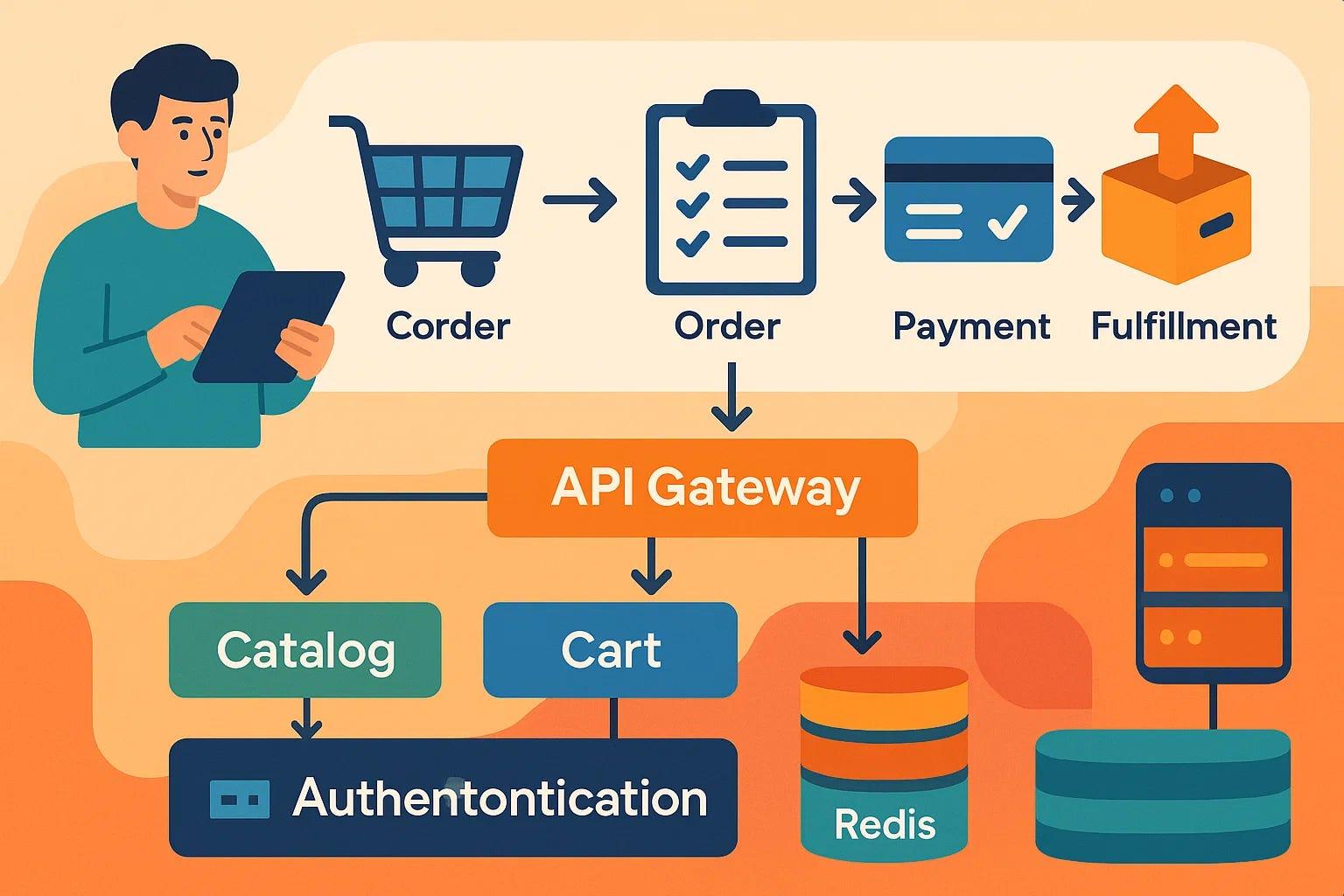
Consider an SME selling computers, electronic components or professional services online. Its digital environment may include:
- A public website and content management system.
- An ecommerce platform such as Magento Open Source.
- REST APIs connecting applications and external suppliers.
- A relational database and product search service.
- Payment gateways and shipping providers.
- CRM, email marketing and customer support systems.
- Backup, monitoring, security and analytics services.
- AI assistants that retrieve information from product documentation or technical knowledge bases.
These components may be operated by different vendors, run on different machines and depend on networks outside the business's control.
A customer might experience the entire environment as one website. Operationally, however, it is a network of interacting components.
If a payment provider responds slowly, the checkout process may stall. If inventory data becomes stale, the business may accept an order for an unavailable product. If an API changes without warning, a previously functional integration may fail. If a database reaches capacity, several seemingly unrelated services may deteriorate simultaneously.
The business implication is clear: reliability must be designed across the complete customer and operational journey, not merely inside individual applications.
2.2 The five engineering challenges and their business consequences
|
Engineering challenge |
Business interpretation |
Typical failure |
|---|---|---|
|
Communication |
Systems exchange information securely and correctly |
Failed integrations or lost requests |
|
Coordination |
Independent components maintain acceptable agreement about shared business state |
Incorrect inventory or inconsistent order status |
|
Scalability |
Capacity grows with demand |
Slow pages, timeouts and abandoned purchases |
|
Resiliency |
Essential operations continue or recover when components fail |
Website outages and interrupted transactions |
|
Maintainability |
Systems can be changed safely and economically |
Expensive upgrades and recurring incidents |
These five areas form a useful assessment framework for organizations deciding whether to maintain an existing system, improve it incrementally or redesign selected components.
Understanding Distributed Systems 2nd edition.pdf
2.3 A business-first approach to architecture
Architecture decisions should start with the business requirement rather than a preference for a particular technology.
For example:
- If the principal problem is missed customer inquiries, improving lead capture and CRM integration may be more valuable than introducing microservices.
- If checkout fails because an external payment service is slow, timeout management and payment-state recovery may be more valuable than adding servers.
- If product searches are slow, query optimization and caching may be sufficient before introducing a separate search architecture.
- If AI responses are inaccurate, improving source quality, retrieval and evaluation may be more important than increasing model size.
KeenComputer can implement the improvements, IAS-Research can evaluate the underlying problem and architecture, and KeenDirect can apply the resulting capabilities to commercial workflows.
3. Communication, APIs and integration engineering
3.1 Why reliable communication is not automatic
Vitillo's discussion of reliable links, secure links, discovery and APIs emphasizes that applications depend on networking mechanisms whose failure modes cannot simply be ignored. The book also discusses HTTP, API resources, request methods, response codes, OpenAPI, API evolution and idempotency.
Understanding Distributed Systems 2nd edition.pdf
For business applications, the resulting engineering requirements include:
- Encrypted communication using appropriately configured TLS.
- Authentication and authorization for API clients.
- Defined request and response schemas.
- Explicit handling of timeouts, errors and unavailable services.
- Backward-compatible API changes where practical.
- Rate limiting and protection against excessive requests.
- Documented and repeatable API testing.
A successful HTTP request does not necessarily mean that the intended business operation completed correctly. The application must distinguish transport success from business success.
3.2 REST APIs as a business integration layer
A RESTful API can connect an ecommerce platform to inventory management, a CRM, a supplier system or a customer-facing application without requiring every component to share its internal implementation.
A sensible API contract defines:
- The resource being accessed.
- The supported operations.
- Authentication and permissions.
- Request and response formats.
- Error codes and recovery behavior.
- Versioning and compatibility expectations.
- Logging, testing and monitoring requirements.
Example: product availability
A customer requests current product availability. The ecommerce application calls an inventory endpoint. The inventory service may return a quantity, an availability category or a temporary error.
The storefront should not interpret an unavailable inventory service as proof that the product is in stock. It needs an explicit fallback policy appropriate to the business.
For KeenDirect, this could be applied to product catalogues, stock visibility, supplier feeds and order workflows. KeenComputer could implement and operate the integration, while IAS-Research could define its contract, evaluate consistency requirements and test alternative designs.
3.3 API validation with Postman and automated testing
Postman can support a repeatable API validation process. The proposed workflow is:
- Maintain collections of API requests and expected responses.
- Separate development, staging and production environments.
- Use controlled test identities and synthetic test data.
- Validate status codes, response schemas, permissions and business rules.
- Test invalid input, expired credentials, timeouts and rate limits.
- Include API checks in the release pipeline where the chosen tooling supports it.
- Monitor production API behavior independently of pre-release tests.
Testing should include negative scenarios. A system that correctly processes an ordinary order but duplicates an order after a network timeout has not been adequately validated.
3.4 Idempotency: preventing duplicate business actions
A particularly important concept in distributed applications is idempotency.
Suppose a customer clicks Pay, the payment service processes the request, but the response is lost. The browser retries. Without suitable safeguards, the business could create a duplicate charge or order.
An idempotency key lets the receiving service recognize repeated attempts belonging to the same logical operation. The application must also define how keys are stored, how long they remain valid and what response is returned for a duplicate request.
This is especially relevant to:
- Payment initiation.
- Order creation.
- Shipping-label generation.
- Supplier purchase orders.
- CRM lead creation.
- Automated AI workflows that trigger business actions.
KeenComputer can implement these safeguards; IAS-Research can review their correctness and failure behavior; KeenDirect can prioritize the transactions where duplication would create customer or financial harm.
4. Coordination, consistency and transaction integrity
4.1 Why multiple systems disagree
Distributed applications often store related information in different places. A product catalogue, inventory service, search index and ecommerce database may each hold a representation of the same product.
Updates do not necessarily reach every component at the same instant.
The architecture must therefore specify which system is authoritative, which copies can become temporarily stale and which operations require stronger consistency.
For example, a slightly delayed product-description update may be tolerable. An incorrect payment status or an oversold product may not be.
The correct consistency model depends on the business operation, not on a blanket rule that every component must always be synchronized immediately.
4.2 The transactional outbox pattern
Vitillo covers asynchronous transactions and the transactional outbox pattern.
Understanding Distributed Systems 2nd edition.pdf
The outbox pattern can address a common integration problem: a business transaction succeeds in the database, but publishing the corresponding event to another service fails.
Instead of treating the database update and message publication as unrelated operations, the application writes the business change and an outgoing event record in the same local database transaction. A separate relay publishes the event. Receivers must handle possible duplicate delivery, commonly through idempotency or deduplication.
For KeenDirect, a product update could trigger a search-index update, catalogue feed or downstream reporting event.
The outbox does not eliminate every failure. It makes the relationship between a committed business change and the intention to publish an event more reliable, provided the relay, retries, monitoring and consumer logic are also implemented correctly.
4.3 Sagas and compensating actions
A saga is useful when a business workflow spans multiple services and cannot be completed as one ordinary database transaction.
Consider an order involving inventory reservation, payment authorization and shipping preparation. If payment succeeds but shipping preparation fails, the system may need to release the inventory reservation, void the authorization or initiate another recovery action.
The correct compensating action depends on what has already occurred. Some actions can be reversed; others, such as a settled payment or dispatched shipment, may require refunds or manual resolution instead.
IAS-Research can help model these business states and recovery rules. KeenComputer can implement the workflow and its operational safeguards. KeenDirect can identify the order, inventory and customer-service processes that need the strongest controls.
4.4 Practical consistency policy
|
Business data |
Suggested design priority |
|---|---|
|
Payment status |
Authoritative transaction record and explicit recovery |
|
Inventory |
Defined reservation and overselling policy |
|
Product descriptions |
Eventual propagation may be acceptable |
|
Search index |
Rebuildable from an authoritative source |
|
CRM activity |
Reliable delivery, duplicate detection and reconciliation |
|
AI knowledge index |
Traceable source updates and controlled re-indexing |
The objective is not to eliminate all temporary inconsistency. It is to ensure that the system handles it predictably and does not misrepresent business state.
5. Scalability, performance and cost control
5.1 Scale only when evidence justifies it
Vitillo examines caching, content delivery networks, partitioning, data storage, load balancing, microservices and messaging as building blocks for scalable applications.
Understanding Distributed Systems 2nd edition.pdf
These are not interchangeable solutions. Each addresses a different constraint.
- Caching reduces repeated work.
- Content delivery networks bring eligible content closer to users.
- Load balancing distributes requests across suitable service instances.
- Database optimization reduces inefficient queries and contention.
- Partitioning distributes data or workloads when one storage unit is insufficient.
- Asynchronous messaging decouples work that does not need to finish during the original request.
- Horizontal scaling increases capacity by adding instances.
For a small business, improving database queries or caching may be more cost-effective than deploying a complex distributed architecture.
5.2 Performance measurement
The proposed assessment should measure at least:
- Page and API response-time percentiles.
- Successful requests per second.
- Error and timeout rates.
- CPU, memory, disk and network utilization.
- Database query latency and connection pressure.
- Cache hit ratio where applicable.
- Queue depth and age of the oldest queued message.
- Checkout completion and failed-order rates.
Business measurements should be evaluated alongside technical measurements. A faster product page is useful, but its commercial significance depends on whether it improves customer experience, conversion or another defined outcome.
5.3 The danger of premature microservices
Microservices can improve independent deployment, ownership and scaling where there is a genuine need. They also introduce network dependencies, distributed data management, additional deployment pipelines and operational complexity.
A modular monolith—with well-defined internal boundaries—may be a better starting point for an SME. Components can be separated when evidence demonstrates a benefit.
IAS-Research can compare architectural options and their long-term costs. KeenComputer can benchmark the current application and implement targeted changes. KeenDirect can apply the improvements to real product, customer and order workflows.
6. Resiliency, security and business continuity
6.1 Design for failure
Vitillo identifies common failure sources such as hardware faults, incorrect error handling, configuration changes, single points of failure, network faults, resource leaks, load pressure and cascading failures. The book also covers redundancy, fault isolation, timeouts, retries, circuit breakers, load shedding, load leveling and rate limiting.
Understanding Distributed Systems 2nd edition.pdf
For an SME, these principles translate into several practical controls:
- Set explicit timeouts for external service calls.
- Use bounded retries with backoff and appropriate safeguards against retry storms.
- Apply circuit breakers where failing downstream services could otherwise consume excessive resources.
- Limit request rates to protect critical services.
- Isolate nonessential tasks from checkout or other business-critical paths.
- Back up important data and test restoration.
- Monitor certificate expiry, failed authentication and unexpected configuration changes.
- Establish incident response, rollback and recovery procedures.
Redundancy alone does not guarantee resilience. Two servers sharing the same failing database, network or credentials may still represent one effective point of failure.
6.2 Security must span the whole system
Securing the public website is only one layer. The same discipline must cover internal APIs, service credentials, administrator accounts, backups, CI/CD pipelines, third-party integrations and AI components.
A proposed security baseline includes:
- Least-privilege access and strong authentication.
- Encryption in transit and appropriate protection of stored data.
- Patch management and controlled configuration changes.
- Centralized logging with suitable access controls.
- Backup isolation and recovery testing.
- Secrets management that avoids hard-coded credentials.
- Dependency and software supply-chain review.
- Documented incident response and recovery responsibilities.
For clients subject to privacy, contractual or industry obligations, controls should be mapped to the requirements actually applicable to their organization. A generic technical assessment is not equivalent to a formal compliance certification.
6.3 Service objectives and downtime
Vitillo discusses service-level indicators (SLIs), service-level objectives (SLOs), alerting and operational monitoring.
Understanding Distributed Systems 2nd edition.pdf
A business can establish objectives such as:
- Availability of critical customer journeys.
- Acceptable checkout error rates.
- Maximum age of inventory updates.
- Time to acknowledge an incident.
- Recovery time for a failed application.
- Maximum tolerable data loss.
These objectives should be agreed with stakeholders and measured over defined periods.
For illustration, 99.9% availability over a 30-day month permits approximately 43.2 minutes of downtime, assuming a continuous 30-day measurement window. This is a mathematical illustration, not a promise that a particular deployment will achieve that availability.
KeenComputer can establish the monitoring and recovery procedures; IAS-Research can help determine appropriate objectives and test assumptions; KeenDirect can identify which customer and revenue workflows warrant the greatest investment.
7. Maintainability, DevOps and continuous delivery
7.1 Engineering does not end at deployment
A production system must remain understandable and modifiable as business requirements, software dependencies and security expectations change.
Vitillo's maintainability section covers testing, continuous delivery and deployment, monitoring, observability and manageability.
Understanding Distributed Systems 2nd edition.pdf
A disciplined lifecycle should include:
- Version-controlled application code and configuration.
- Automated unit, integration and end-to-end tests.
- Reproducible build and deployment procedures.
- Development, staging and production environments.
- Review and testing of configuration changes.
- Release health checks and rollback plans.
- Monitoring and incident feedback.
- Documentation that reflects the actual deployed system.
7.2 A practical DevOps model for an SME
A lean delivery pipeline could be:
1. Requirements and architecture
Business goals, acceptance criteria and design decisions
2. Build and validate
Code review, unit tests, API tests and security checks
3. Staging and acceptance
Integration, performance and end-to-end validation
4. Controlled production release
Approval, deployment, health checks and rollback readiness
5. Operate and improve
Metrics, logs, traces, incident learning and prioritized improvements
This process should be scaled to the client's risk and budget. A small website may require a relatively simple pipeline, while an ecommerce platform processing payments and inventory changes needs more comprehensive validation.
The important principle is to make releases repeatable and observable rather than dependent on undocumented manual steps.
8. Reference architecture: integrating websites, ecommerce, APIs and AI
The following architecture is a proposed design pattern for SME digital transformation. It is not intended to imply that every client needs every component.
Business and customer channels
Website • Ecommerce • Mobile application • Staff portal
Security and API access layer
TLS • Authentication • Authorization • Rate limiting • API gateway where justified
Commerce services
Catalogue, pricing, cart, orders and customer accounts
Business integrations
CRM, inventory, suppliers, payment and shipping
Data and messaging
Authoritative databases, caches, event queues and search indexes
AI and knowledge services
Document retrieval, RAG-LLM, recommendations and assisted workflows
Shared operational foundation
Monitoring • Logs and traces • Backups • Secrets • CI/CD • Recovery • Access control
8.1 Architectural principles
Keep business logic independent of infrastructure details. Vitillo discusses ports-and-adapters architecture and dependency inversion: application logic should depend on well-defined interfaces rather than being tightly coupled to a particular database or communication mechanism.
Understanding Distributed Systems 2nd edition.pdf
Choose the simplest architecture that meets the requirements. Start with clear application boundaries. Introduce separately deployed services when independent scaling, isolation, ownership or deployment provides a measurable benefit.
Treat external services as unreliable dependencies. Payment, shipping, supplier and AI APIs require timeout policies, error handling and recovery strategies.
Make data ownership explicit. Every critical business entity should have a defined authoritative source, even if other systems hold replicated or derived copies.
Make operations observable. Each important business transaction should be traceable across relevant components without exposing sensitive customer information in logs.
8.2 Applying the architecture to Magento and AI-assisted commerce
For an ecommerce business, a practical initial implementation might use:
- Magento Open Source for catalogue, cart and order management.
- REST APIs for authorized integrations.
- Postman and automated tests for API validation.
- A relational database for authoritative transactional data.
- Caching and search infrastructure selected according to measured needs.
- An asynchronous event mechanism for suitable background workflows.
- A retrieval-augmented generation (RAG) service for product manuals and technical support content.
- Centralized monitoring, backup and controlled deployment procedures.
AI should not become an uncontrolled authority over prices, inventory or payment status. The commerce system should remain authoritative for those business records, while the AI service retrieves relevant information and invokes explicitly authorized operations when appropriate.
This design can support a gradual transition from a conventional ecommerce platform to a more integrated digital business without requiring a wholesale rewrite.
9. Strategic roles of KeenComputer, IAS-Research and KeenDirect
The strongest partnership model is not three organizations selling overlapping technical services. It is three complementary capabilities operating across a common client lifecycle.
9.1 KeenComputer.com — Engineering and operational execution
Proposed role: Implementation, integration and managed technology services
KeenComputer can turn architecture into functioning business systems and take responsibility for agreed implementation and operational tasks.
Potential service areas
- Website and ecommerce engineering, modernization and maintenance.
- Linux, VPS, web-server, database and application operations.
- REST API development and third-party integration.
- Security hardening, backup validation and recovery planning.
- DevOps automation, release management and performance optimization.
- Monitoring, troubleshooting and ongoing technical support.
Business value: One accountable engineering partner for converting recommendations into tested, deployable and supportable solutions.
9.2 IAS-Research.com — Research and architectural intelligence
Proposed role: Research, technical advisory and engineering assurance
IAS-Research can help clients make technically defensible decisions before committing substantial resources to an implementation.
Potential service areas
- Architecture assessment and modernization roadmaps.
- Distributed systems design reviews and failure-mode analysis.
- API contracts, domain boundaries and data consistency strategy.
- AI/RAG-LLM feasibility, evaluation and integration design.
- Performance experiments, technical prototypes and proof-of-concept studies.
- Engineering white papers, reference architectures and technical due diligence.
Business value: Reduce avoidable design mistakes, expose assumptions early and connect research to implementable engineering decisions.
9.3 KeenDirect.com — Digital commerce and operational application
Proposed role: Commerce solutions, business workflows and market-facing applications
KeenDirect can provide a practical business context in which the engineering and research capabilities are applied to customer-facing and operational problems.
Potential service areas
- Ecommerce storefront and product catalogue engineering.
- Product, pricing, inventory and order workflow integration.
- Customer experience and conversion-oriented improvements.
- Supplier data integration and operational automation.
- AI-assisted product discovery and documentation-based customer support.
- Reusable commerce patterns and demonstrable technical prototypes.
Business value: Connect infrastructure and software engineering investments to customer experience, operational efficiency and commercial objectives.
9.4 The combined value proposition
The proposed partnership creates a continuous delivery model:
Discover and assess — IAS-Research
Identify business constraints, technical risks and measurable objectives.
Design and implement — KeenComputer
Build, integrate, secure and validate the agreed solution.
Apply and commercialize — KeenDirect
Apply reusable capabilities to commerce and customer workflows.
Measure and improve — All three
Evaluate results, resolve operational issues and prioritize the next improvement.
This model can be used for client engagements, internal product development and joint technical publications. It also allows each organization to retain a distinct role while contributing to a shared solution.
10. Priority client use cases
|
Client challenge |
Proposed solution |
Primary roles |
|---|---|---|
|
Slow or unstable business website |
Performance assessment, query optimization, caching and monitoring |
KCS + IASR |
|
Fragile legacy application |
Architecture review, modularization and controlled modernization |
IASR + KCS |
|
Ecommerce integration failures |
API contracts, idempotency, retries and reconciliation |
KCS + IASR + KeenDirect |
|
Inconsistent inventory and product data |
Data ownership, event-driven updates and recovery procedures |
IASR + KCS + KeenDirect |
|
Poorly grounded AI customer support |
Curated knowledge base, retrieval evaluation and guarded integrations |
IASR + KCS |
|
Repeated deployment incidents |
CI/CD, staging, automated tests and rollback procedures |
KCS + IASR |
|
Unclear technology investment priorities |
Technical audit, risk assessment and phased roadmap |
IASR + KCS |
Recommended initial market
A practical initial focus would be SMEs that depend on websites, ecommerce or integrated business applications but lack a large in-house engineering and operations team.
Potential sectors include computer and electronics retailers, professional services, trades, specialist distributors and other businesses with integration or reliability problems.
The offer should lead with a business problem—lost leads, unreliable checkout, expensive maintenance, slow applications or insecure infrastructure—not with a list of tools.
11. Proposed commercial service portfolio
The following is a suggested portfolio for joint development, rather than a statement of currently available or contracted services.
Offer 1 — Distributed Systems and Integration Audit
Entry offer
Purpose: Establish the current state, principal risks and highest-value improvements.
Deliverables:
- Architecture and dependency map.
- API and integration inventory.
- Review of security, backups, performance and failure handling.
- Prioritized risk register.
- Phased remediation roadmap and proposed success measures.
Lead: IAS-Research, with KeenComputer performing agreed technical validation.
Offer 2 — Secure and Reliable Digital Platform
Purpose: Implement the highest-priority improvements from the audit.
Deliverables may include:
- Website or ecommerce remediation.
- API integration and automated validation.
- Backup and recovery improvements.
- Monitoring, deployment controls and operational documentation.
- Performance and security testing.
Lead: KeenComputer, with IAS-Research reviewing design and KeenDirect supplying commerce use cases where relevant.
Offer 3 — AI-Enabled Commerce and Knowledge Integration
Purpose: Add useful AI capabilities without compromising core business data or transaction integrity.
Deliverables may include:
- Product and technical-document knowledge retrieval.
- RAG evaluation and source attribution.
- Controlled access to approved APIs.
- Human review for consequential actions.
- Monitoring of quality, cost, latency and failures.
Lead: IAS-Research for feasibility and evaluation; KeenComputer for implementation; KeenDirect for commerce applications.
11.1 Pricing and engagement discipline
A sensible commercial approach is to quote each engagement according to scope, complexity, risk and support requirements. Fixed-price discovery and assessment packages may make the first engagement easier to approve; implementation can then be scoped using the assessment findings.
Recurring operations should define included services, support hours, response targets, exclusions, recovery responsibilities and change-control arrangements.
Do not promise specific uptime, savings, conversion improvements or AI accuracy before establishing the baseline and validating the proposed solution.
12. Implementation roadmap
The following 90-day roadmap is a proposed starting point. It should be adjusted to the client's budget, technical environment and operational risk.
Days 1–15
Discover
Architecture and business assessment
- Interview business and technical stakeholders.
- Identify critical customer and operational journeys.
- Inventory applications, APIs, databases and external dependencies.
- Establish baseline metrics and the principal business risks.
- Agree on scope, ownership and measurable objectives.
Days 16–30
Design
Prioritized technical design
- Define target architecture and API contracts.
- Identify the authoritative source for critical business data.
- Specify failure handling, security controls and recovery expectations.
- Select the smallest set of changes likely to address the primary problems.
- Establish test and rollback plans.
Days 31–60
Implement
Engineering and integration
- Implement the highest-priority remediation items.
- Add API and integration tests.
- Improve backup validation and deployment controls.
- Add monitoring for critical business journeys.
- Validate performance and failure behavior in staging.
Days 61–90
Operate
Production validation and continuous improvement
- Release changes using controlled procedures.
- Compare results with the agreed baseline.
- Test recovery and document operational procedures.
- Review incidents, performance and remaining risks.
- Agree on the next phase and ongoing support model.
A 90-day engagement cannot guarantee complete modernization. Its objective is to establish a defensible baseline, deliver a bounded set of improvements and create a repeatable path toward longer-term resilience.
13. Measurement framework
The partnership should judge success by observable results rather than the number of technologies deployed.
|
Measurement area |
Example metric |
Purpose |
|---|---|---|
|
Reliability |
Availability and failed-request rate |
Assess service health |
|
Performance |
Response-time percentiles |
Identify customer-facing delays |
|
Integration |
Failed or duplicate business operations |
Assess transaction correctness |
|
Data consistency |
Age of stale inventory or catalogue updates |
Evaluate propagation behavior |
|
Recovery |
Restore-test results and recovery time |
Assess continuity readiness |
|
Delivery |
Change failure rate and rollback frequency |
Evaluate release quality |
|
Security |
Remediation of agreed critical findings |
Track risk reduction |
|
Commerce |
Checkout completion and failed-order rate |
Assess customer-journey performance |
|
Operations |
Time to detect, acknowledge and resolve incidents |
Assess support effectiveness |
|
Economics |
Infrastructure, support and incident costs |
Evaluate operating efficiency |
Metrics need agreed definitions, measurement windows and reliable collection methods. Targets should be set after understanding the baseline and business priorities.
14. Principal risks and governance
The proposed partnership must avoid several common traps.
Overengineering. Microservices, distributed databases and event-streaming infrastructure may create more operational work than they remove. Architecture choices should follow evidence.
Unclear accountability. The client agreement should specify who owns architecture decisions, implementation, production access, incident response and third-party vendor relationships.
Unreliable integrations. API failures, duplicate messages and delayed data must be handled explicitly rather than hidden behind a successful deployment.
Uncontrolled AI actions. AI components should use narrowly scoped permissions, validated inputs, auditable actions and human approval where the potential consequences justify it.
Unproven commercial claims. Performance gains, cost savings and business improvements must be measured rather than inferred from technology adoption.
Security gaps between organizations. Joint delivery requires appropriate access controls, secure information sharing, documented ownership and agreed procedures for handling client data.
A shared architecture review, documented acceptance criteria, change control and regular operational review can provide a lightweight governance structure without imposing unnecessary enterprise bureaucracy.
15. Strategic recommendations
The following actions offer a practical route from the white paper to a functioning joint business model.
- Develop one clearly defined assessment offer. Start with distributed systems reliability, API integration, security and operational readiness.
- Create a reusable engineering baseline. Include architecture diagrams, API conventions, automated test templates, monitoring standards and recovery checklists.
- Use KeenDirect as a commerce application context. Identify suitable catalogue, inventory, order and AI-knowledge workflows that can demonstrate the approach.
- Publish evidence-led research. IAS-Research can develop technical notes and white papers describing problems, architecture alternatives, validation methods and measured results.
- Establish an implementation and support model. KeenComputer can translate assessment findings into scoped engineering work and ongoing operational services.
- Develop case studies only after validation. Record the baseline, changes, limitations and measured outcomes, with client permission.
- Review the partnership quarterly. Assess service profitability, delivery quality, client satisfaction, recurring issues and opportunities for reusable intellectual property.
The goal is to build a repeatable capability rather than treating every client engagement as a completely new technical project.
16. Conclusion
Distributed systems engineering is directly relevant to the reliability and competitiveness of modern digital businesses. Communication failures, inconsistent data, overloaded services, cascading outages and difficult software changes can undermine even well-designed business applications.
Vitillo's Understanding Distributed Systems provides a useful conceptual framework for addressing these challenges through secure communication, coordination, scalability, resiliency and maintainability. The practical opportunity is to translate these principles into architecture decisions, implementation standards, operational controls and measurable business outcomes.
The proposed strategic partnership gives each organization a distinct contribution:
- IAS-Research.com develops the research, architecture, evaluation and technical decision-making capability.
- KeenComputer.com provides the engineering implementation, integration and operational execution.
- KeenDirect.com applies the capabilities to ecommerce and customer-facing business workflows.
Together, they can offer SMEs a coherent path from understanding a technology problem to implementing, operating and improving a solution.
The long-term competitive advantage will not come from adopting the greatest number of tools or the most complicated architecture. It will come from repeatedly solving the right business problems with systems that are secure, understandable, resilient, maintainable and economically justified.
Strategic call to action
Move from architecture discussion to measurable improvement
Begin with a focused assessment of one business-critical application, website or integration workflow. Establish the baseline, identify the highest-impact risks and select a bounded improvement that can be tested and measured.
IAS-Research.com
Define the assessment, analyze architectural risks and develop the prioritized roadmap.
KeenComputer.com
Implement and validate the agreed engineering changes and establish operational procedures.
KeenDirect.com
Identify commerce workflows and customer outcomes that can benefit from the improved capabilities.
Recommended first milestone: a documented architecture baseline, prioritized risk register, measurable objectives and a 90-day implementation plan.
References and further reading
Primary source
1. Vitillo, R. (2022). Understanding Distributed Systems: What Every Developer Should Know About Large Distributed Applications, Second Edition, Version 2.0.0. The uploaded edition covers communication, coordination, scalability, resiliency and maintainability, including APIs, consistency, transactions, caching, microservices, messaging, testing, deployment, monitoring and observability.
Understanding Distributed Systems 2nd edition.pdf
Foundational and supplementary engineering references
2. Fielding, R. T. (2000). Architectural Styles and the Design of Network-based Software Architectures. Doctoral dissertation, University of California, Irvine. Foundational reference for REST architectural constraints.
3. Kleppmann, M. (2017). Designing Data-Intensive Applications. O'Reilly Media. Reference for data systems, replication, partitioning, transactions and distributed processing.
4. Newman, S. (2021). Building Microservices, 2nd ed. O'Reilly Media. Reference for service boundaries, deployment, distributed-system trade-offs and operational complexity.
5. Fowler, M. (2002). “Patterns of Enterprise Application Architecture.” Addison-Wesley. Reference for enterprise application structure and recurring design patterns.
6. Nygard, M. T. (2018). Release It!, 2nd ed. Pragmatic Bookshelf. Reference for stability, failure isolation and production-oriented system design.
7. Richardson, C. Microservices Patterns. Manning Publications. Reference for transactional outbox, sagas and other distributed application patterns.
8. Beyer, B., Jones, C., Petoff, J., and Murphy, N. R., eds. (2016). Site Reliability Engineering: How Google Runs Production Systems. O'Reilly Media. Reference for service objectives, monitoring, incident management and reliability engineering.
9. Fielding, R., Nottingham, M., and Reschke, J. (2022). RFC 9110: HTTP Semantics. Internet Engineering Task Force. https://www.rfc-editor.org/rfc/rfc9110
10. OpenAPI Initiative. OpenAPI Specification. https://spec.openapis.org/oas/latest.html
Publication note: This paper is an independently developed research and strategy synthesis. The primary source is attributed, the proposed partnership model is identified as a recommendation, and the supplementary bibliography provides starting points for further investigation rather than implying that each source has been exhaustively reviewed in this paper.